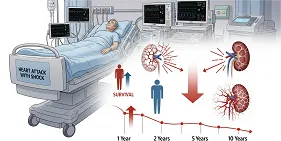
A study in European Heart Journal-Acute Cardiovascular Care found that the patients who develop acute kidney injury (AKI) after suffering a heart attack with cardiogenic shock face significantly worse long-term outcomes, including higher risks of death and kidney complications.
The study included 1,473 patients admitted with acute myocardial infarction and cardiogenic shock between 2010 and 2017. The research aimed to assess how AKI impacts both survival and kidney health over time.
The study reported that 44% of patients developed AKI during hospitalization, and 25% required renal replacement therapy (RRT). Risk factors significantly linked to the development of AKI, included older age, diabetes, low ejection fraction, and high lactate levels on admission. These factors suggest that patients who are already in a vulnerable physiological state are more likely to experience kidney complications during treatment for cardiogenic shock.
Patients who developed AKI had significantly higher mortality at 30 days, and 1, 5, and 10 years, compared to those who did not. At 10 years, AKI was linked to more than a 30% increase in mortality (p < 0.001).
AKI also had a strong association with long-term kidney morbidity. The study reported a significantly higher 10-year cumulative incidence of chronic kidney disease and dialysis requirement in patients who received renal replacement therapy during their hospital stay, even after adjustment for the competing risk of death (p < 0.001).