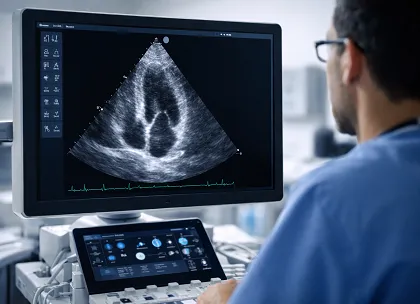
Diagnosing cardiac amyloidosis (CA) on echocardiography remains challenging because of overlap with more common hypertrophic conditions. In this retrospective analysis of 5776 patients (2756 CA; 3020 controls), investigators evaluated AI-derived measurements incorporated into a multiparametric echocardiographic score and developed a fully automated deep-learning video-based model for CA detection. The study was published in the Circulation: Cardiovascular Imaging.
The training cohort included patients from the UK National Amyloidosis Center and Taiwan MacKay Memorial Hospital (CA 2241; controls 2130). External validation cohorts were drawn from the US Duke University Health System (CA 334; LVH controls 668) and Japan National Cerebral and Cardiovascular Center (CA 181; LVH controls 222).
The AI-derived multiparametric score achieved accuracies of 79.5% (sensitivity 75.4%; specificity 81.5%) in the US cohort and 79.7% (sensitivity 81.6%; specificity 78.1%) in Japan. The deep-learning model demonstrated internal validation and test accuracies of 96.2% and 95.8%, respectively. External validation showed accuracies of 87.5% (US) and 88.4% (Japan). The deep-learning model showed higher overall discrimination than the AI score (AUC 0.93 [95% CI 0.91–0.95] vs 0.88 [95% CI 0.85–0.90]; P<0.001).
Limitations include retrospective design, testing in high-prevalence populations, potential labeling limitations in one training cohort, and inability of the multiparametric score to classify some patients.
Both AI approaches demonstrated diagnostic performance for CA across diverse cohorts, with the deep-learning model showing higher discrimination. Prospective validation in broader populations is required.