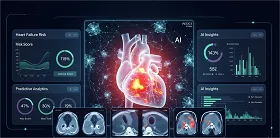
Researchers have shown that artificial intelligence (AI) can extract clinically meaningful cardiac measurements from the ultralow-dose CT scans to improve risk prediction for heart failure. The study was published in Circulation: Cardiovascular Imaging.
The study analyzed 18,079 patients undergoing cardiac PET/CT at six sites. Using a deep learning model, investigators derived cardiac chamber volumes (right atrial, right ventricular, left ventricular, and left atrial) and left ventricular mass from CT attenuation correction scans. These measures were then evaluated for their association with myocardial flow reserve and heart failure hospitalization.
Over a median follow-up of 4.3 years, 1,721 patients (9.5%) were hospitalized for heart failure. Patients with abnormalities in three or more cardiac chambers were seven times more likely to be hospitalized compared with those with normal volumes.
The study reported an independent association of higher volumes of the left atrium, right atrium, right ventricle, and left ventricle, and increased left ventricular mass with an elevated risk of heart failure. Left atrial volume and left ventricular mass emerged as independent predictors of reduced myocardial flow reserve.