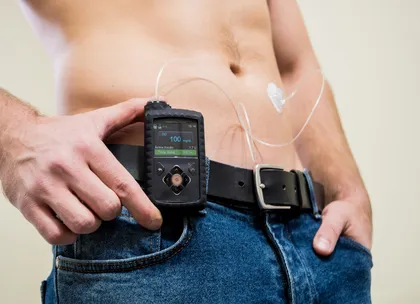
Managing insulin therapy in people with diabetes and advanced chronic kidney disease (CKD) remains challenging because impaired kidney function can alter insulin clearance and contribute to glycemic variability. A prospective, randomized crossover trial published in Diabetologia evaluated whether automated insulin delivery (AID) could improve glucose outcomes compared with usual care in adults with diabetes complicated by advanced CKD.
The study enrolled 40 adults aged 18 years or older with type 1 diabetes or insulin-treated type 2 diabetes and stage 3b CKD or more advanced disease, including individuals receiving dialysis. Participants were randomly assigned in a 1:1 sequence to receive either AID followed by usual care with real-time continuous glucose monitoring (CGM), or the reverse sequence, with each treatment period lasting 8 weeks.
Median age was 60 years, median glycated hemoglobin (HbA1c) was 8.0%, and median estimated glomerular filtration rate (eGFR) was 30 mL/min per 1.73 m². The primary endpoint was percentage time in range (TIR) (3.9-10.0 mmol/L) during the final 3 weeks of each treatment period.
Findings
- TIR increased from 60% (IQR 51%-66%) during usual care to 73% (IQR 65%-78%) with AID (p<0.001).
- Hyperglycemic CGM metrics improved significantly during AID treatment compared with usual care.
- Hypoglycemia rates remained unchanged between treatment approaches.
- Participants were predominantly pre-frail at baseline and remained stable during the trial.
- No serious adverse events were attributed to study devices.
- Ten participants required hospital admission during the study period for medical issues unrelated to device use.
The findings suggest that AID is feasible and safe in adults with diabetes and advanced CKD and may improve CGM-based glucose outcomes compared with usual care.