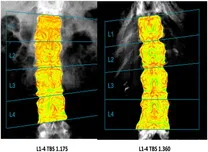
Higher arterial stiffness is associated with deterioration in bone microstructure in individuals with type 2 diabetes mellitus (T2DM). The study, published in the Journal of Diabetes, examined the relationship between baPWV and two bone quality metrics: TBS and BMD.
The analysis included 646 adults with T2DM who underwent L1-L4 TBS measurement using dual-energy X-ray bone densitometry. Stepwise linear regression identified independent factors associated with L1-L4 TBS. The association between baPWV and TBS was evaluated using sequentially adjusted linear regression models, while the relationship between baPWV and BMD was assessed using univariable and multivariable analyses.
Age, body mass index (BMI), urinary albumin-to-creatinine ratio, diastolic blood pressure, total type I collagen N-terminal propeptide, alkaline phosphatase, and baPWV were independent determinants of L1-L4 TBS. baPWV maintained a significant inverse association with TBS (β = −0.076; 95% CI −0.114 to −0.038) across models. A baPWV threshold of 1531 cm/s marked a substantial rise in the likelihood of degraded bone microarchitecture. baPWV did not independently correlate with BMD after full adjustment.
These findings indicate that arterial stiffness may contribute to bone microarchitectural decline in T2DM and support further investigation into the clinical relevance of the bone-vascular axis.