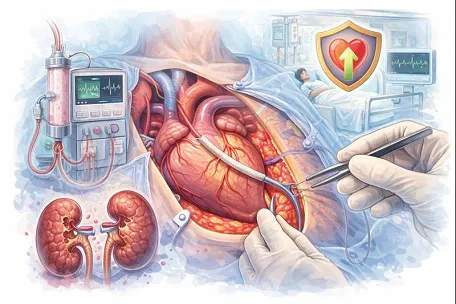
A large analysis from the United States Renal Data System tracked 16,616 ESRD patients receiving isolated coronary artery bypass grafting from 2015 to 2021, comparing artery-based grafts against saphenous vein grafts alone while noting who later got kidney transplants. The results of the analysis were published in the Annals of Thoracic Surgery.
ESRD patients face grim odds after CABG due to high morbidity, yet arterial grafts like the left internal mammary artery (LIMA) or multiarterial grafting (MAG) promise better long-term vessel patency than veins. Researchers split cases into LIMA plus SVG (89.8%, n=14,917), MAG (3.1%, n=512), and SVG only (7.1%, n=1,187).
LIMA Gives Clear Early Survival Edge
After adjustments, LIMA grafting lifted 5-year survival to 31.6% versus 26.6% for SVG-only in non-transplant patients (P<0.001), confirming arteries outperform veins in keeping blood flowing long-term. This early boost matters hugely for ESRD patients with halved life expectancy, where even short gains reduce heart failure or repeat surgeries. Landmark analysis showed the advantage peaking early but fading after four years, likely as kidney disease and vein failures catch up. Cardiac surgeons will recognize LIMA's reliability here, mirroring benefits in lower-risk groups but tempered by dialysis demands.
No Extra Wins from Multiple Arteries
MAG failed to top LIMA at five years, hitting 31.7% survival in non-transplant cases (P=0.21) and 80.5% in transplant recipients versus 84.8% for LIMA (P=0.65). Small MAG numbers limited power, yet no signal emerged of added value despite theoretical durability. Transplants dramatically improved survival across grafts, underscoring dialysis-to-transplant timing as the dominant driver over graft choice. Nephrologists and surgeons gain clarity: focus on LIMA as standard while pushing transplant lists.
Real-World Data Guides Tough Choices
IPTW ensured fair comparisons despite baseline imbalances, with hospital deaths low across groups. ESRD's vascular fragility makes arterial patency crucial, yet progression to transplant often overshadows graft effects long-term. Limited MAG cases highlight needs for bigger studies, but LIMA's consistent edge supports its routine use pre-transplant.
Practical Takeaways for High-Risk CABG
These findings reinforce LIMA for ESRD CABG patients not nearing transplants, buying vital early years without multiarterial complexity. Teams should prioritize transplant evaluation alongside optimal revascularization, tailoring to patient frailty and wait times. As ESRD heart surgery volumes rise, this data sharpens decisions balancing short gains against lifelong kidney failure burdens.
Featured
Off
Page Content
#ffffff
Anonymous user
On
Authenticated user
On
Premium
On
Paid / Sponsored
On
Key highlights
- LIMA grafting improved 5-year survival by 5% over SVG-only in ESRD CABG patients who did not receive kidney transplants.
- The LIMA survival benefit peaked early and diminished after four years in non-transplant patients.
- Multiarterial grafting showed no 5-year survival advantage over LIMA regardless of transplant status.
- Kidney transplantation dramatically boosted long-term survival across all graft types in ESRD patients.
- Inverse probability weighting balanced groups effectively, confirming LIMA as the reliable choice for early gains.
Source
Yang C, Singh S, Ogami T, et al. Arterial Grafting Survival Benefit in Patients With End-Stage Renal Disease Undergoing Coronary Artery Bypass Grafting. Ann Thorac Surg. 2025 Sep 2:S0003-4975(25)00841-0. doi: https://doi.org/10.1016/j.athoracsur.2025.07.057.
Thumbnail
Speciality
Currency
Sub Speciality
Sub Sub Speciality
Short Description
LIMA artery grafts improve 5-year survival in ESRD patients undergoing CABG who skip transplants, but multiarterial benefits fade fast and remain unproven in this high-risk group.
User Segments
Release Date
Featured Order
0
Is Paid
0
Send Notification
Off