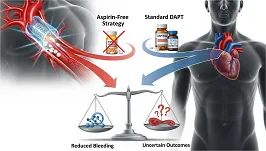
A subgroup analysis from the STOPDAPT-3 trial suggests that an aspirin-free approach may be a feasible option for certain high bleeding risk (HBR) patients undergoing percutaneous coronary intervention (PCI). Still, it raises concerns about its use in patients with acute coronary syndrome (ACS). The results of the analysis were published in the Circulation: Cardiovascular Interventions.
The study examined 3,258 HBR patients, including 1,803 with ACS and 1,455 without ACS, to evaluate the impact of dropping aspirin and continuing with prasugrel monotherapy versus continuing dual antiplatelet therapy (DAPT) one month after PCI. Researchers focused on bleeding events and major cardiovascular outcomes.
The results reported no significant difference in major bleeding between the aspirin-free and DAPT groups, regardless of ACS status. Among ACS patients, bleeding occurred in 7.3% on prasugrel monotherapy compared to 7.9% on DAPT (HR 0.91), and among non-ACS patients, 3.1% vs. 2.9% (HR 1.06).
However, ACS patients receiving aspirin-free therapy experienced a higher (but not statistically significant) rate of serious cardiovascular events, including death, myocardial infarction, stent thrombosis, and ischemic stroke (7.9% vs. 5.8%; HR 1.39). No such trend was seen in non-ACS patients.
Further, ACS patients on aspirin-free therapy had a higher rate of MI (1.6% vs. 0.3%; HR 4.57), while no such effect was seen in non-ACS patients (1.4% vs. 1.8%; HR 0.78; P interaction = 0.02).