A Faster Marker Than Troponin
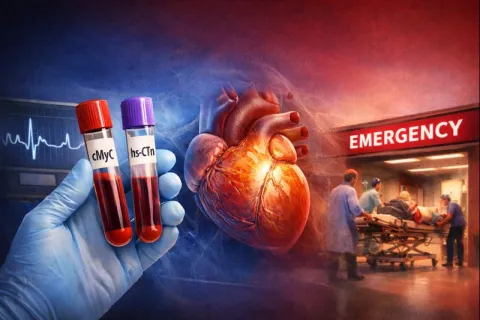
Cardiac myosin‑binding protein C (cMyC) is a cardiac‑specific sarcomeric protein with faster release kinetics than high‑sensitivity troponin, making it an attractive candidate for early infarct detection.
In this secondary analysis of a large, international prospective cohort of 4,735 ED patients with suspected NSTEMI, investigators measured cMyC on a prototype automated immunoassay at presentation and compared its diagnostic performance with hs‑cTnT and hs‑cTnI. The study was published in the Journal of the American College of Cardiology.
The primary diagnostic endpoint was index NSTEMI (18% of patients, n=854). Prognostic endpoints were cardiovascular death or MI at 30 days, 1 year, and 5 years.
Better Discrimination, Especially in Very Early Presenters
At ED arrival, cMyC differentiated NSTEMI slightly better than hs‑cTnT overall, and more clearly in patients presenting very early after symptom onset.
Overall AUC for NSTEMI was 0.943 (95% CI 0.936–0.95) for cMyC and 0.936 (95% CI 0.929–0.944; P = 0.008) for hs‑cTnT. In patients with chest pain onset ≤3 hours, the cMyC AUC was 0.939 (95% CI 0.928–0.951) and hs‑cTnT AUC was 0.921 (95% CI 0.907–0.936; P < 0.001).
For the clinician at the front door of the ED, this means cMyC is more informative when it matters most, i.e., in the early time window where troponin can still be equivocal.
One Tube, Two Markers: Tripling Immediate Rule‑Out
The most practice‑changing aspect of the study is a single‑sample dual‑biomarker strategy, combining hs‑cTn (T or I) with cMyC at presentation.
Investigators compared the standard hs‑cTn‑only single‑sample algorithm (similar to current ESC‑endorsed thresholds) and the dual‑marker algorithm using both hs‑cTn and cMyC to assign patients to rule‑out or rule‑in at the index blood draw.
The study found that the overall triage efficacy (proportion of patients immediately ruled‑out or ruled‑in) jumped from 26.8% with hs‑cTnT alone to 60.0% with hs‑cTnT + cMyC, without loss of safety. Further, the dual‑biomarker strategy identified up to three times more patients for instant rule‑out, yet maintained comparable sensitivity.
In other words, adding cMyC allowed clinicians to safely discharge far more patients after a single blood draw, without paying a price in missed events or downstream risk.
What This Means for Busy EDs
If validated further and made widely available, a single‑tube cMyC + hs‑cTn strategy could reshape chest pain workflows. It may lead to fewer serial blood draws and shorter ED lengths of stay for low‑risk patients, less ED crowding and better resource utilization, as more patients are safely ruled‑out early, and maintained or even improved safety, given better early discrimination in patients presenting within 3 hours of symptom onset.
For now, cMyC remains a prototype assay, not ready to replace hs‑cTn in guidelines. But this study positions it as a powerful adjunct: a faster‑releasing, heart‑specific marker that adds incremental value to troponin, especially when clinicians need extra diagnostic clarity.
Featured
Off
Page Content
#ffffff
Anonymous user
On
Authenticated user
On
Premium
On
Paid / Sponsored
On
Key highlights
- cMyC provides significant incremental value to hs‑cTn for early NSTEMI diagnosis.
- cMyC improves diagnostic discrimination compared to hs‑cTn alone.
- Dual‑biomarker strategy (cMyC + hs‑cTn) enables more patients to be safely ruled out immediately.
- Single blood draw approach is particularly attractive for busy EDs.
- Dual‑biomarker strategy offers simplicity and quick time‑to‑decision.
Source
Lopez-Ayala P, Boeddinghaus J, Koechlin L, et al. Incremental Value of Cardiac Myosin-Binding Protein C for the Early Diagnosis of Acute Myocardial Infarction. J Am Coll Cardiol. 2025 Dec 23;86(25):2616-2632. doi: https://doi.org/10.1016/j.jacc.2025.09.008.
Thumbnail
Speciality
Currency
Sub Speciality
Sub Sub Speciality
Short Description
Emergency physicians may soon be able to send far more low‑risk chest pain patients home after a single blood draw, thanks to a new cardiac biomarker that appears to outperform and complement high‑sensitivity troponins for very early NSTEMI diagnosis.
User Segments
Release Date
Featured Order
0
Is Paid
0
Send Notification
Off