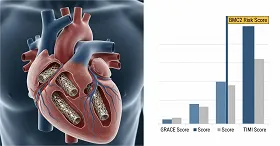
It is important to predict the actual risk of the patients before performing high risk percutaneous coronary intervention.
A new study has found that the Blue Cross Blue Shield of Michigan Cardiovascular Consortium 2 (BMC2) risk score more accurately predicts mortality and major adverse cardiac and cerebrovascular events (MACCEs) in patients who were undergoing complex and high-risk percutaneous coronary intervention (CHIP-PCI) compared with two widely used scoring systems. The findings were reported in the Canadian Journal of Cardiology.
Researchers evaluated 4,287 CHIP-PCI patients at a specialized center, where in-hospital mortality occurred in 2.5% and MACCEs in 3.3% of cases. Performance of the BMC2 score, the National Cardiovascular Data Registry (NCDR) CathPCI score, and the British Cardiovascular Intervention Society (BCIS)-CHIP score was compared using discrimination (AUC) and calibration metrics.
The BMC2 score achieved the highest predictive accuracy for both mortality (AUC = 0.93) and MACCEs (AUC = 0.87), significantly outperforming NCDR CathPCI (AUC = 0.89 and 0.83) and BCIS-CHIP (AUC = 0.81 and 0.78).
Subgroup analysis showed the BMC2 model’s advantage was even greater in patients undergoing chronic total occlusion and multivessel PCI. Calibration indicated good predictive accuracy overall, although BMC2 tended to slightly overestimate risk in low-risk patients.
Key Takeaways
BMC2 outperformed NCDR CathPCI and BCIS-CHIP in predicting mortality and MACCE after CHIP-PCI. BMC2 showed slight risk overestimation in low-risk patients but strong overall accuracy.