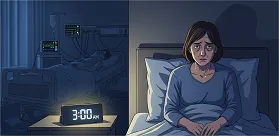
Close family members of cardiac arrest survivors face significant declines in sleep quality and duration, alongside higher rates of daytime dysfunction, according to findings from a prospective study conducted at an academic medical center. The results were published in the Journal of Cardiac Failure.
The study followed 102 family members of cardiac arrest patients admitted between August 2021 and June 2023. Sleep health was measured using the Pittsburgh Sleep Quality Index (PSQI), while depression severity was assessed using the Patient Health Questionnaire-8 (PHQ-8).
Results revealed that global PSQI scores worsened one month after the event compared to baseline (7.4 vs. 6.2; P < .01), indicating poorer sleep quality. Those with higher depressive symptoms had the greatest sleep deterioration, even after adjusting for demographics, psychiatric history, and patient outcomes.
Families also reported that receiving clear and timely information was a higher priority than well-being-focused interventions in alleviating distress (76% vs. 34%; P < .01).