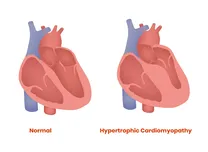
Higher epicardial fat surrounding the heart may signal a more aggressive clinical course in hypertrophic cardiomyopathy. A study published in the European Heart Journal – Cardiovascular Imaging evaluated how epicardial adipose tissue (EAT) measured on cardiac magnetic resonance imaging contributes to outcome prediction in patients with hypertrophic cardiomyopathy.
The analysis included 457 patients who underwent cardiac MRI between 2018 and 2024. Over a median follow-up of 27.5 months, 18.1% experienced major adverse cardiovascular events. Patients with these events had significantly higher EATVI (72.21 ± 14.21 vs 56.71 ± 10.36 ml/m², P<.001) and greater regional fat thickness (P<0.05). EATVI remained an independent predictor of adverse outcomes (hazard ratio 1.03, 95% CI 1.01–1.05, P<.001) and strengthened predictive accuracy when added to both clinical and ESC HCM risk models.
Incorporating EATVI improved discrimination in the clinical-CMR model (C-statistic 0.82 to 0.84, P=0.002) and enhanced net clinical benefit on decision-curve analysis. Adding EATVI to the ESC HCM Risk-SCD model increased discrimination from 0.71 to 0.80 (P<.001), with better calibration. Event-free survival worsened across increasing quartiles of EATVI, and the 62.5 ml/m² cutoff distinguished outcomes even in ESC-defined low-risk patients.
Epicardial fat may reflect metabolic and inflammatory stress that contributes to arrhythmias and structural deterioration. Integrating these measurements into routine imaging evaluations could help clinicians identify high-risk patients earlier and refine individualized management strategies.