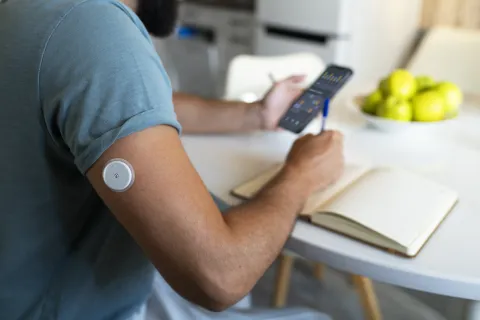
Continuous glucose monitoring (CGM) offers a more detailed view of glycaemic fluctuations than conventional capillary glucose testing. A secondary analysis of the randomized GOLD trial, reported in Frontiers in Clinical Diabetes and Healthcare, assessed whether replacing self-monitoring of blood glucose (SMBG) with CGM affected the Glycaemia Risk Index (GRI), a composite indicator derived from CGM data that combines information on both hypoglycaemia and hyperglycaemia to reflect overall glycaemic status.
The analysis included 125 adults with type 1 diabetes mellitus (T1DM) treated with multiple daily injection (MDI) insulin therapy. Participants alternated between CGM and SMBG across two 26-week treatment phases, separated by a 17-week wash-out interval. GRI values were generated on a 0-100 scale using CGM-derived data and grouped into five predefined risk categories. Relationships between baseline factors and participant-reported measures, including diabetes management behaviors, lifestyle characteristics, and psychological attributes, were also evaluated for their association with changes in GRI.
Use of CGM instead of SMBG was associated with a 9.8-point decrease in overall GRI (95% CI −13.3 to −6.3). Reductions occurred in both the hypoglycaemia component (−1.8) and the hyperglycaemia component (−2.8). The GRI category remained unchanged or shifted to a lower risk level in 85.4% of participants. Although GRI demonstrated a moderate inverse relationship with time in range (TIR), the magnitude of change was larger for GRI than for TIR based on standardized effect size comparisons. Additional exploratory analyses indicated that certain self-reported psychosocial characteristics were associated with variations in GRI improvement.
The analysis indicated that switching from SMBG to CGM lowered GRI in adults with T1DM receiving MDI therapy. Because GRI integrates both low- and high-glucose exposure, the metric may provide a useful endpoint for evaluating glycaemic interventions and may complement other CGM-derived measures in clinical assessment.