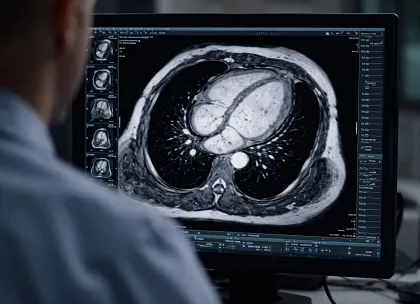
Cardiac magnetic resonance (CMR) accurately measures left ventricular ejection fraction (LVEF) and late gadolinium enhancement (LGE), though its role in diastolic evaluation is less established. A retrospective cohort study published in the Journal of Cardiovascular Magnetic Resonance analyzed 391 patients with preserved LVEF (≥50%) and absence of LGE to determine the prognostic relevance of CMR-derived diastolic parameters.
Left ventricular (LV) cine-derived diastolic time–volume curves were used to quantify early peak filling rate (E-PFR) indexed to stroke volume index (SVI), E/A ratio, and deceleration time (Decelt), alongside left atrial volume index (LAVI) and LV mass index (LVMI). K-means clustering based on these variables identified distinct phenogroups. The primary composite endpoint included heart failure or ventricular arrhythmia hospitalization, heart transplantation, mechanical circulatory support, and cardiac death.
Over a median follow-up of 5 years, 30 events were recorded. Three clusters demonstrated graded event rates of 2.6%, 8.5%, and 17.2%. Group 2 showed lower filling indices with lower E-PFR (6.5 vs 9.7 and 8.4 SVI/s), reduced E/A ratio (1.2 vs 2.4 and 1.9), and prolonged Decelt (223 vs 79 and 105 ms) compared with groups 1 and 3 (all p<0.001).
Group 3 showed structural remodeling with higher LAVI (51.4 vs 26.6 and 27.5 mL/m²) and LVMI (78.7 vs 48.7 and 50.6 g/m²) (p<0.001). Relative to group 1, hazard ratios (HR) for events were 3.21 (95% CI 1.06–9.68) in group 2 and 2.52 (95% CI 1.06–4.47) in group 3. After adjustment, only group 3 remained significant (HR 2.55; 95% CI 1.42–4.57).
CMR-derived diastolic phenotyping identified prognostic subgroups despite preserved systolic function. These findings suggest cine-derived diastolic metrics may provide additional prognostic information in this population.