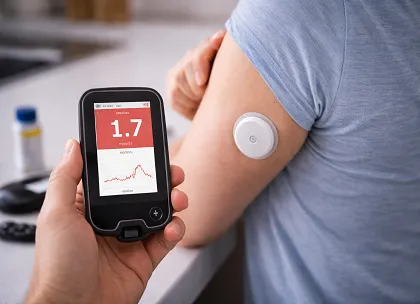
Continuous ketone monitoring (CKM) may provide additional metabolic insights in type 1 diabetes. This analysis published in the Diabetes Technology & Therapeutics examined two-week CKM run-in data from 64 community-dwelling adults enrolled in the PARTNER study (ACTRN12624000448549). Participants had a median age of 49.8 years (IQR 40.2–64.1) and HbA1c of 7.4% (57 mmol/mol; IQR 6.9–8.0%). Ketone categories were defined as <0.6, 0.6–0.9, and ≥1.0 mmol/L based on at least one reading in the highest observed range.
Overall, 61% of participants consistently had ketones <0.6 mmol/L. Peak ketones of 0.6–0.9 mmol/L occurred in 23%, and ≥1.0 mmol/L in 16%. Maximum time-in-range for ketones 0.6–0.9 mmol/L and ≥1.0 mmol/L was 5.3% and 2.4%, respectively. Median glucose was on average 47 mg/dL higher (95% CI 19–73; P=0.001) during episodes with ketones ≥1.0 mmol/L compared with time-matched periods <0.6 mmol/L.
Limitations include small sample size, short monitoring duration, and potential behavioral influence due to unmasked CGM/CKM data within a clinical trial setting.
Most adults with type 1 diabetes in this cohort had ketone levels <0.6 mmol/L. Elevated ketones were associated with higher glucose levels, though glucose alone was not a diagnostic substitute for ketone status.