Circadian misalignment contributes to metabolic dysregulation in type 2 diabetes, with meal timing and macronutrient composition potentially modulating peripheral clock gene expression and glycemic homeostasis.
This randomized crossover trial, published in the Diabetologia, conducted at Wolfson Medical Center enrolled 25 adults with type 2 diabetes (HbA1c ≥6.5%) managed by stable oral agents or diet alone, randomizing them to sequential four-week phases of isoenergetic dairy-enriched (YesMilk) versus non-dairy (NoMilk) diets separated by three-to-four-week washout.
Clock Gene Upregulation With Dairy Phase
Nineteen participants completed both phases, with 13 starting YesMilk and all finishing, versus six of 12 NoMilk starters. The YesMilk diet significantly upregulated core clock genes versus NoMilk: BMAL1 increased 1.8-fold (P=0.0003), REV-ERBα (NR1D1) rose 2.2-fold (P<0.001), CRY1 elevated 1.4-fold (P=0.03), and PER1 showed higher expression at four weeks (P=0.01). These molecular shifts confirm dairy protein sources enhance circadian oscillator coherence when paired with consistent meal timing.
Glycemic Improvements Parallel Molecular Effects
Continuous glucose monitoring revealed superior glycemic profiles during YesMilk phase, including fasting glucose reduction of approximately 1.7 mmol/L, glucose management indicator decrease of 0.7%, and time-in-range improvement by 9% versus baseline (all P<0.05). These changes occurred independently of weight variation, suggesting direct metabolic clock-mediated benefits.
Appetite Suppression Complements Metabolic Gains
Hunger scores declined 15-20% and sweet cravings reduced similarly (P<0.05) with dairy enrichment, potentially reflecting branched-chain amino acid signaling or circadian alignment effects on hypothalamic regulation.
Precision Nutrition Implications for Diabetes Practice
Endocrinologists gain mechanistic evidence linking dairy protein timing to circadian-metabolic axis restoration in type 2 diabetes. Structured meal schedules incorporating high-quality dairy sources offer accessible intervention enhancing endogenous insulin sensitivity and appetite control without pharmaceutical escalation. Larger confirmatory trials should validate long-term durability and explore mechanistic mediators including casein-derived peptides and leucine signaling.
Featured
Off
Page Content
#ffffff
Anonymous user
On
Authenticated user
On
Premium
On
Paid / Sponsored
On
Key highlights
- Dairy-enriched diet upregulates BMAL1 1.8-fold (P=0.0003), REV-ERBα 2.2-fold (P<0.001), and CRY1 1.4-fold (P=0.03) versus non-dairy phase.
- YesMilk phase reduces fasting glucose by 1.7 mmol/L, glucose management indicator by 0.7%, and increases time-in-range by 9% (all P<0.05).
- Hunger and sweet craving scores decrease 15-20% with dairy intervention (P<0.05).
- Structured meal timing with dairy protein sources enhances circadian clock coherence in peripheral blood mononuclear cells.
- Molecular and metabolic improvements occur without weight change, supporting direct circadian-mediated benefits.
Source
Tsameret S, Froy O, Matz Y, et al. Glycaemic, appetite and circadian benefits of a dairy-enriched diet with high-protein breakfast and early daytime-restricted carbohydrate intake in type 2 diabetes: a randomised crossover trial. Diabetologia. Published online January 23, 2026. doi: https://doi.org/10.1007/s00125-025-06658-2
Thumbnail
Speciality
Currency
Sub Sub Speciality
Short Description
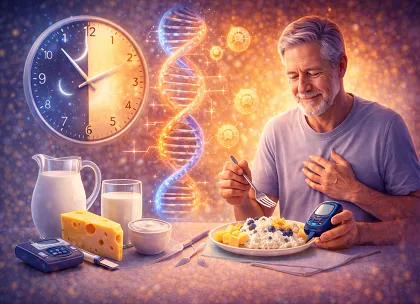
Randomized crossover trial demonstrates dairy-enriched diet with structured meal timing upregulates BMAL1, REV-ERBα, and CRY1 expression while improving glycemic control and reducing appetite in 19 type 2 diabetes patients.
User Segments
Release Date
Featured Order
0
Is Paid
0
Send Notification
Off