From Myosin Mechanism to Clinical Testing
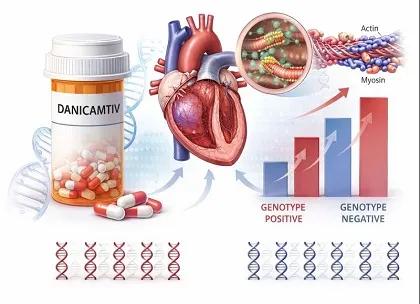
Danicamtiv selectively enhances cardiac myosin function, directly targeting the motor protein impairment characteristic of dilated cardiomyopathy caused by MYH7 and TTN pathogenic variants. In vitro studies demonstrated that the drug increased the activity of both wild-type and DCM-variant myosin while boosting force generation in skinned left ventricular fibers, providing the mechanistic foundation for human testing.
Phase 2a Trial Design and Cohorts
This baseline-controlled, open-label phase 2a trial, published in the Journal of the American College of Cardiology, enrolled 41 DCM patients with a mean age of 49.6 years and baseline LVEF 33.4%, stratified into three cohorts based on etiology: 12 patients with MYH7 variants, 14 with TTN variants, and 15 with other/unknown DCM causes. Participants received oral danicamtiv 25 mg twice daily during treatment period 1, followed by dose adjustment to 10 mg or 50 mg twice daily in period 2. The primary endpoint of the study was safety/tolerability, while secondary endpoints included echocardiography-assessed alterations in the cardiac structure and function.
Safety Profile Supports Further Development
Treatment-emergent adverse events occurred in 22 of 41 participants (53.7%), all characterized as mild or moderate, with only one treatment discontinuation. An asymptomatic cardiac troponin increase was detected in three patients from the other causes cohort, representing the principal safety signal while establishing general tolerability across genotype groups.
Genotype-Driven Contractile Response
Echocardiographic evaluation after treatment period 2 revealed clear differentiation by genotype. Patients with MYH7 variants achieved an 8.8% absolute LVEF improvement (95% CI: 5.03%-12.64%), while TTN variant carriers demonstrated 5.9% LVEF gain (95% CI: 2.59%-9.28%). The other causes cohort showed a more modest 4.4% improvement (95% CI: −0.90% to 9.73%), confirming MYH7 and TTN patients exhibited the most favorable contractile responses consistent with a myosin-targeted mechanism.
Precision Therapy Implications
MYH7 and TTN genotype carriers represent a myosin-activatable DCM subset gaining 6-9% absolute LVEF improvement through brief targeted sarcomere enhancement, establishing proof-of-concept for genotype-directed contractile therapy. The differential response validates genetic testing as a therapeutic guide rather than an academic exercise alone.
Clinical Translation Potential
Danicamtiv's phase 2a success positions myosin activation as a viable strategy for genetically defined DCM, with safety supporting phase 3 investigation.
Featured
Off
Page Content
#ffffff
Anonymous user
On
Authenticated user
On
Premium
On
Paid / Sponsored
On
Key highlights
- Danicamtiv's in vitro myosin enhancement prompted human clinical testing.
- Short-course treatment was generally well tolerated in DCM patients.
- Echocardiography confirmed myosin function improvement.
- MYH7 and TTN genotype cohorts showed the most favorable contractile responses.
Source
Lakdawala NK, Hershberger RE, Garcia-Pavia P, et al. Danicamtiv, a Selective Agonist of Cardiac Myosin, for Dilated Cardiomyopathy: A Phase 2 Open-Label Trial. J Am Coll Cardiol. 2025 Dec 23;86(25):2598-2612. doi: https://doi.org/10.1016/j.jacc.2025.09.1511
Thumbnail
Speciality
Currency
Sub Speciality
Sub Sub Speciality
Short Description
A novel cardiac myosin activator, danicamtiv, demonstrates genotype-specific LVEF improvements in dilated cardiomyopathy (DCM) patients carrying MYH7 or TTN.
User Segments
Release Date
Featured Order
0
Is Paid
0
Send Notification
Off