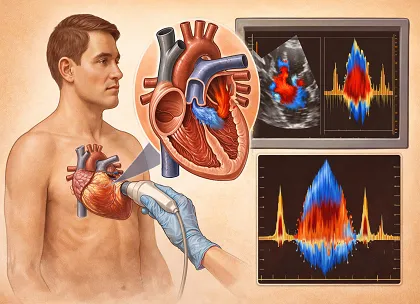
Doctors assessing functional tricuspid regurgitation (fTR) often rely on continuous-wave Doppler (CWD) envelopes to gauge severity, as these shapes reflect the interplay of blood flow, pressure differences, and resistance across the valve. While the v-wave cutoff pattern clearly marks severe cases, researchers from a study of 245 fTR patients explored the full range of CWD shapes from mild to worst, using both visual scoring (parabolic, triangular, v-wave cutoff) and new quantitative measures like the Vmax/Vmean ratio and time-to-peak velocity corrected for regurgitation duration (TTP/TRD). They graded TR with the corrected proximal isovelocity surface area method and linked these Doppler features to right heart function, effective regurgitant orifice area, and patient outcomes including death or heart failure hospitalization.
CWD Shapes Progress with TR Severity
The Vmax/Vmean ratio steadily rises as fTR worsens, starting at 1.26 ± 0.07 for parabolic shapes in milder cases, climbing to 1.32 ± 0.10 for triangular shapes without v-wave, and peaking at 1.42 ± 0.14 for v-wave cutoff in the most severe group, with all differences reaching high statistical significance (P < .001). Parameters like peak velocity (Vmax), regurgitant orifice size, and right ventricular function strongly correlate with both Vmax/Vmean and TTP/TRD, confirming that Doppler patterns capture hydraulic stress on the right heart. Clinicians can now interpret these shapes as direct severity gauges during routine echoes, spotting progression from rounded parabolic flows to sharp triangular peaks and finally flattened v-waves.
Vmax/Vmean Predicts Heart Failure Outcomes
Patients with higher Vmax/Vmean ratios face worse prognoses, as this measure independently ties to the combined risk of death and heart failure hospitalization with an adjusted hazard ratio of 1.32 (95% CI 1.09-1.60, P = .004). Survival curves separate clearly by tertiles, with the highest group (Vmax/Vmean >1.33) showing significantly poorer outcomes than the middle tertile (log-rank P = .004), offering a simple cutoff for risk talks. Although Vmax/Vmean adds no benefit beyond regurgitant orifice area alone in layered models (P = .2), TTP/TRD fails to predict events, positioning Vmax/Vmean as the go-to metric for quick echo-based stratification.
Simple Echo Tool Changes Right Heart Care
Echo laboratories can obtain an easy Vmax/Vmean number from standard continuous-wave Doppler tracings without requiring extra software to identify high-risk functional tricuspid regurgitation beyond traditional measures like vena contracta or jet area. For volume-overloaded patient showing parabolic Doppler, monitor closely but provide reassurance about lower immediate risk. Triangular or v-wave patterns require escalation with stronger diuretics, consideration of surgery timing, or addition of right ventricular protectants. This approach directly links valve leakage severity to right heart strain, thereby guiding targeted interventions such as tricuspid repair during left-sided heart procedures.
Risk Stratification Sharpens Daily Practice
Heart failure teams now quantify functional tricuspid regurgitation danger using Vmax/Vmean alongside effective regurgitant orifice area, thereby personalizing follow-up plans from clinic visits to catheterization laboratory procedures. Families understand clear explanations such as, "This Doppler shape indicates higher heart strain, so let's take action early." Future guidelines may standardize this measure, which would help reduce overtreatment of mild leaks.
Featured
Off
Page Content
#ffffff
Anonymous user
On
Authenticated user
On
Premium
On
Paid / Sponsored
On
Key highlights
- The Vmax/Vmean ratio increases progressively from parabolic (1.26) to triangular (1.32) to v-wave cutoff (1.42) shapes as functional tricuspid regurgitation worsens.
- Vmax, effective regurgitant orifice area, and right ventricular function parameters correlate strongly with both Vmax/Vmean and TTP/TRD measures.
- Higher Vmax/Vmean independently predicts death or heart failure hospitalization (adjusted HR 1.32), with clear separation in tertile-based survival curves.
- Vmax/Vmean provides prognostic value but adds no benefit beyond effective regurgitant orifice area in multivariate models.
- Clinicians can use Vmax/Vmean from routine continuous-wave Doppler as a simple tool for risk stratification in tricuspid regurgitation patients.
Source
Iturriagagoitia A, Calle S, Van Overmeiren T, et al. Quantitative Doppler Shape Analysis in Functional Tricuspid Regurgitation. J Am Soc Echocardiogr. 2026 Jan;39(1):43-54. doi: https://doi.org/10.1016/j.echo.2025.08.018.
Thumbnail
Speciality
Currency
Sub Speciality
Sub Sub Speciality
Short Description
Vmax/Vmean ratio from Doppler envelopes predicts outcomes in functional tricuspid regurgitation, rising with severity and independently flagging death or heart failure risk in echo-assessed patients.
User Segments
Release Date
Featured Order
0
Is Paid
0
Send Notification
Off