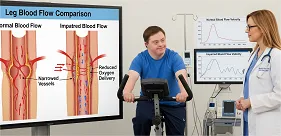
A new study has revealed that individuals with Down syndrome (DS) have significantly impaired blood flow and vascular responses during lower limb exercise. The study focused on how autonomic dysfunction may limit physical performance in this population. The findings were reported in the American Journal of Physiology-Heart and Circulatory Physiology.
The study compared 24 individuals with DS (average age 24 years) and 24 age- and sex-matched individuals without DS as they performed a series of knee extension exercises at varying intensities, both relative (10%, 20%, and 30% of maximal dynamic power) and absolute (11 Nm and 16 Nm).
Researchers measured femoral artery blood flow (FaBF), mean arterial pressure (MAP), and vascular conductance (FaVC) using Doppler ultrasound and finger photoplethysmography.
Across all exercise intensities, individuals with DS demonstrated approximately 50–55% lower blood flow and 46–53% lower vascular conductance to their active limb compared to those without DS, despite similar blood pressure readings.
Further, instead of appropriately increasing blood delivery to working muscles, individuals with DS showed an unfavorable increase in blood flow to their inactive limb during higher exercise intensity.