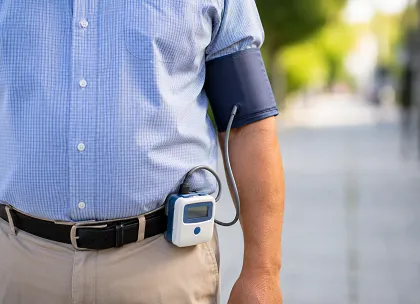
The relative contribution of daytime and nighttime blood pressure (BP) to cerebral small vessel disease (CSVD) remains uncertain. A meta-analysis presented at the ESH Congress 2026 evaluated associations between ambulatory blood pressure monitoring (ABPM) parameters and imaging markers of CSVD.
The analysis systematically reviewed studies assessing 24-hour, daytime, and nighttime BP measurements, along with nocturnal BP dipping patterns, in relation to white matter hyperintensities, lacunes, and cerebral microbleeds.
A total of d 24 studies involving 6,822 patients were included in the quantitative synthesis, with pooled analyses conducted across 19 studies. Study quality was assessed using the Newcastle-Ottawa Scale.
Findings
- Pooled analysis showed that higher 24-hour systolic blood pressure (SBP) was associated with a 41% increased risk of CSVD.
- Similar associations with CSVD were observed for both daytime and nighttime SBP.
- Non-dipping nocturnal BP patterns were associated with higher odds of CSVD compared with normal dipping patterns (OR, 2.24; 95% CI, 1.31–3.16).
- Reverse-dipping BP patterns were associated with higher odds of cerebral microbleeds (OR, 3.02; 95% CI, 1.61-4.42).
- Associations between ambulatory BP parameters and CSVD appeared to be largely driven by cerebral microbleeds.
The findings suggest that multiple ABPM components, including 24-hour, daytime, nighttime, and nocturnal BP patterns, may help identify patients at higher risk for CSVD and its imaging subtypes, particularly cerebral microbleeds.