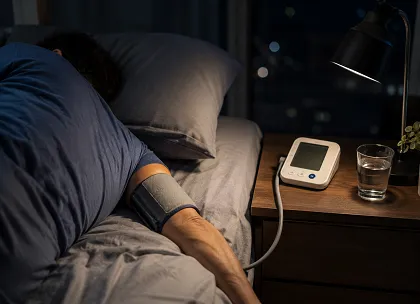
Home blood pressure monitoring (HBPM) devices capable of obtaining nighttime measurements may provide a more accessible alternative for identifying abnormal nocturnal blood pressure patterns.
In a study presented at the ESH 2026, the investigators evaluated the accuracy of a novel nocturnal HBPM system in comparison with the reference-standard method of 24-hour ambulatory blood pressure monitoring (ABPM). Over a two-week period, 46 patients with chronic kidney disease (CKD), underwent both 24-hour ABPM and structured home blood pressure monitoring.
Findings
- Home nighttime systolic blood pressure underestimated ambulatory nighttime systolic blood pressure by a mean of 2.2 mmHg (mean difference, –2.2 mmHg; 95% limits of agreement, –21.7 to 17.4 mmHg).
- Nocturnal HBPM demonstrated good diagnostic performance for detecting ambulatory nighttime systolic blood pressure ≥120 mmHg, with an area under the curve of 0.837 (95% CI, 0.717–0.957).
- A nighttime home systolic blood pressure threshold of 116.5 mmHg provided a sensitivity of 86.4% and specificity of 77.3% for diagnosing nocturnal hypertension.
- Agreement between HBPM and ABPM for assessment of nocturnal blood pressure patterns was substantial, with 21.7% of patients classified as dippers by both methods.
The findings suggest that nocturnal home blood pressure monitoring may offer a practical and reasonably accurate alternative for detecting nocturnal hypertension and abnormal circadian blood pressure patterns in patients with CKD.\