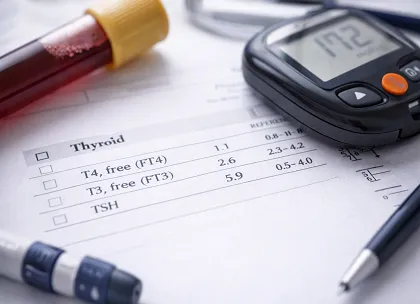
Sarcopenia is common in individuals with type 2 diabetes mellitus (T2DM), yet simple biomarkers for early risk identification remain limited. This cross-sectional study, published in the Journal of Diabetes Research, analyzed 1,823 adults with T2DM (2019–2023) to examine associations between euthyroid-range thyroid hormones and sarcopenia. Sarcopenia was defined according to Asian Working Group for Sarcopenia 2019 criteria. Muscle mass was measured using multifrequency bioelectrical impedance analysis, handgrip strength via dynamometer, and gait speed using a 6-m walk test. Multivariable models adjusted for demographics, diabetes duration, body mass index, nephropathy, glycated hemoglobin, and antidiabetic medications.
Higher free triiodothyronine (FT3) levels were associated with greater muscle mass, stronger handgrip, and faster gait speed. Among thyroid markers, FT3 showed the strongest discrimination for sarcopenia (AUROC 0.633). An optimal FT3 cutoff of 3.62 pmol/L yielded sensitivity of 85.6% and specificity of 35.7%, though overall performance was modest. Low FT3 independently predicted sarcopenia (OR 2.26; p=0.002). The association remained significant in females (OR 3.29) but not males (OR 1.83), without significant sex interaction. Adding FT3 to the adjusted model modestly improved discrimination (ΔAUROC 0.007; significant net reclassification improvement at the 25th percentile risk).
The cross-sectional design precludes causal inference. Single-time thyroid measurement, lack of nutrition and physical activity data, use of BIA instead of DXA, and recruitment from tertiary hospitals in China may limit generalizability.
FT3 within the euthyroid range demonstrated modest discrimination for sarcopenia risk in T2DM. Findings support further longitudinal evaluation before clinical application.