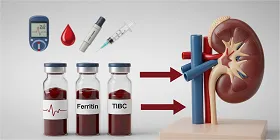
A study published in Journal of Diabetes Research showed a potential causal relationship of iron status with renal function in patients with diabetes. The study evaluated genetic data associated with iron markers such as ferritin, serum iron, transferrin saturation (TSAT), and total iron-binding capacity (TIBC). The researchers analyzed their impact on kidney outcomes across both type 1 and type 2 diabetes.
The researchers used genome-wide association studies (GWAS) data. The outcomes assessed were diabetic nephropathy, type 1 diabetes mellitus (T1DM) with renal complications, type 2 diabetes mellitus (T2DM) with renal complications, estimated glomerular filtration rate based on creatinine (eGFRcrea), and urinary albumin-to-creatinine ratio (UACR).
The researchers found that ferritin levels had a causal role in reducing eGFRcrea in people with diabetes (OR = 0.937, 95% CI: 0.887–0.990), indicating worsening kidney function. Moreover, higher ferritin levels were also linked to an increased risk of T1DM with renal complications (OR = 1.783, 95% CI: 1.005–3.162).
Higher levels of TIBC showed a protective effect. TIBC was causally associated with a reduced risk of diabetic nephropathy (OR = 0.864, 95% CI: 0.771–0.968) and also lowered the risk of T1DM with renal complications (OR = 0.743, 95% CI: 0.603–0.916).