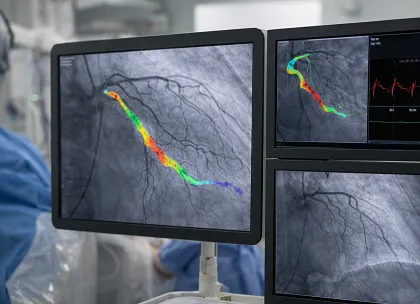
For patients undergoing valve surgery with concomitant coronary artery disease (CAD), current practice recommends coronary artery bypass grafting (CABG) guided by angiographic stenosis severity. The FAVOR IV-QVAS trial published in the Lancet evaluated whether a physiologically guided strategy using angiography-derived fractional flow reserve (FFR) improves outcomes compared with conventional angiography-guided CABG.
This multicentre, randomized, triple-blind trial enrolled adults aged ≥18 years scheduled for valve surgery with at least one clinically significant stenosis in a major coronary artery. Participants were assigned (1:1) to FFR-guided CABG (FFR ≤0.80) or angiography-guided CABG (stenosis ≥50%). The modified intention-to-treat population included patients who underwent surgery with available primary outcome data.
A total of 793 patients were randomized, with 792 included in the primary analysis. Concomitant CABG was performed less frequently in the FFR-guided group (56%) than in the angiography-guided group (98%).
The primary composite endpoint at 30 days, death, myocardial infarction (MI), stroke, unplanned revascularization, or new dialysis-dependent renal failure, occurred in 7.8% of the FFR group versus 13.4% of the angiography group (risk ratio 0.58; 95% confidence interval [CI] 0.38–0.89; P=0.011). At median follow-up of 27 months, the key secondary composite outcome occurred in 20.7% versus 26.8% (hazard ratio 0.74; 95% CI 0.55–0.98; P=0.036).
FFR-guided CABG reduced perioperative and longer-term composite adverse events. These findings support a selective, physiology-based approach to surgical revascularization.