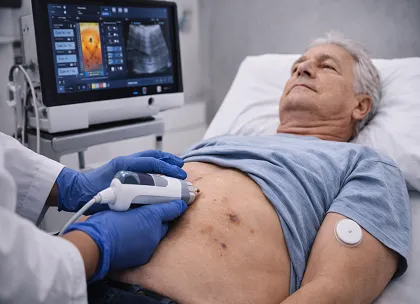
Non-invasive tests (NITs) such as Fibrosis-4 (FIB-4) and NAFLD fibrosis score (NFS) are commonly used to assess hepatic fibrosis, but data in Indian patients with type 2 diabetes mellitus (T2DM) and metabolic dysfunction–associated steatotic liver disease (MASLD) remain limited. In this prospective study of 789 individuals (238 females; mean age 53.3 ± 10.3 years), liver stiffness measurement (LSM) by vibration-controlled transient elastography (VCTE) was used as reference, with ≥9.7 kPa defining advanced fibrosis. The study was published in the Diabetes & Metabolic Syndrome: Clinical Research & Reviews.
LSM ≥9.7 kPa was present in 102 patients (12.9%). The optimal rule-in cut-off for FIB-4 was 1.68 (AUROC 0.69; 95% CI 0.637–0.746; sensitivity 64.7%; specificity 65.2%). For NFS, the optimal rule-in cut-off was −0.389 (AUROC 0.619; 95% CI 0.560–0.678; sensitivity 61.8%; specificity 57.4%). Rule-out performance was limited (AUROC 0.586 for FIB-4; 0.570 for NFS).
Previously suggested rule-in cut-offs (FIB-4 >2.67; NFS >0.675) showed high specificity (92.2% and 90.1%, respectively) but low sensitivity (22.1% and 21.3%). Rule-out cut-offs demonstrated modest diagnostic accuracy (52.7% for FIB-4 <1.3; 53.8% for NFS <−1.455).
In this cohort, FIB-4 and NFS showed limited discrimination for advanced fibrosis. These findings suggest caution when applying standard NIT thresholds in Indian patients with T2DM and MASLD.