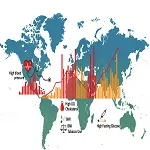
An analysis reported in Journal of the American College of Cardiology has projected a worrisome future for cardiovascular health. It revealed that age-standardized rates for disability-adjusted life years (DALYs) linked to modifiable cardiovascular risk factors are expected to decline by 2050. The overall crude burden will rise significantly because of population growth and aging.
The researchers used the data from the Global Burden of Disease (GBD) 2021 study. They assessed long-term trends in five key modifiable risk factors, i.e., high fasting plasma glucose, high systolic blood pressure (SBP), high low-density lipoprotein (LDL) cholesterol, high body mass index (BMI), and tobacco use, across various global regions, age groups, demographic indices, and sexes. The forecasts range from 2025 to 2050.
By 2050, high systolic blood pressure is expected to remain the leading contributor to cardiovascular DALYs globally, with an estimated 1,694.2 per 100,000 population, followed by high LDL cholesterol (657.6 per 100,000), high BMI (495.2 per 100,000), tobacco use (493.7 per 100,000), and high fasting plasma glucose (466.7 per 100,000).
There may be a reduction in the age-standardized rates for all risk factors. However, the absolute number of DALYs is predicted to rise. High SBP might have a 44.1% increase (99 million additional DALYs) by 2050. High BMI will account for an 88.0% increase (44 million additional DALYs).