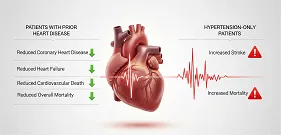
A comprehensive review of 74 randomized trials involving more than 157,000 patients found that heart rate (HR)-lowering drugs can significantly reduce the risk of coronary heart disease, heart failure, cardiovascular mortality, and all-cause mortality; however, benefits appear limited to specific patient groups. The findings were published in the European Heart Journal.
On average, HR-lowering treatment reduced heart rate by 8 beats per minute over 2.7 years. The analysis reported 16% reduction in coronary heart disease, 9% reduction in heart failure, 14% reduction in cardiovascular mortality, and 13% reduction in overall mortality. These benefits were most in patients with prior acute myocardial infarction or existing heart failure.
However, patients with hypertension but no cardiovascular disease did not see significant improvements, and the hypertensive population even showed an increased risk of stroke and mortality. HR-lowering therapy increased treatment discontinuation due to adverse events by 25%.