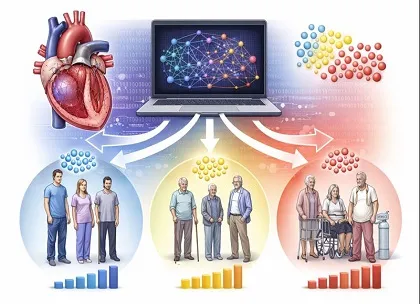
Heart failure with reduced ejection fraction patients defy uniform management despite guideline-directed medical therapy, prompting researchers to apply machine learning across clinical, ECG, echocardiographic, biomarker, and proteomic data from 564 VICTORIA trial participants. The analysis was published in the Circulation: Heart Failure.
The Three Faces of HFrEF
Phenogroup 1 represents younger patients optimally treated with guideline-directed medical therapy who are least likely to have implantable cardioverter defibrillators and serve as the lowest-risk reference cohort. Phenogroup 2 carries the highest prevalence of atrial fibrillation alongside pathological Q-waves, suggesting prior infarction or scar burden, positioning this group at intermediate risk. Phenogroup 3 encompasses the oldest patients exhibiting biventricular dysfunction and advanced renal disease, manifesting the highest event rates with a hazard ratio of 7.0 compared to phenogroup 1.
GDF-15 Emerges as Master Biomarker
Multinomial logistic regression identified growth differentiation factor 15 as the most critical protein discriminating all three phenogroups in both VICTORIA and the external validation cohort BIOSTAT-CHF. This mitokine integrates multisystem physiologic stress beyond traditional markers, offering superior phenogroup separation.
External Validation Confirms Phenogroup Stability
BIOSTAT-CHF replication demonstrated phenogroup 3 consistency through older age, renal dysfunction, and elevated event rates, establishing these machine learning-derived subgroups as robust across independent international datasets rather than cohort-specific artifacts.
Precision Heart Failure Management Achieved
Machine learning transforms HFrEF from a heterogeneous syndrome to three biologically coherent phenogroups spanning sevenfold outcome differences, externally validated across continents with GDF-15 as master discriminator. Clinicians gain precision risk stratification, while patients gain therapies matched to underlying pathophysiology. HFrEF management enters its precision medicine era.
Featured
Off
Page Content
#ffffff
Anonymous user
On
Authenticated user
On
Premium
On
Paid / Sponsored
On
Key highlights
- Three distinct HFrEF phenogroups identified with shared characteristics stratifying HF hospitalization/CV death risk.
- Phenogroup 1 was younger, GDMT-optimized, ICD-least likely (lowest risk), phenogroup 2 had the highest AF and pathological Q-waves prevalence (intermediate risk), and phenogroup 3 was the oldest with biventricular dysfunction and renal disease (highest risk).
- GDF-15 most informative biomarker for phenogroup assignment.
- These HFrEF phenogroups based on multimodality data provided enhanced risk prognostication beyond traditional clinical characteristics.
Source
Shah P, Zheng Y, Pieske B, et al. Phenomapping in Heart Failure With Reduced Ejection Fraction to Identify Subpopulations With High Residual Risk: A VICTORIA Substudy. Circ Heart Fail. 2025 Oct 8:e013166. doi: https://doi.org/10.1161/CIRCHEARTFAILURE.125.013166
Thumbnail
Speciality
Currency
Sub Speciality
Sub Sub Speciality
Short Description
Using agglomerative hierarchical clustering of 105 variables, investigators identified three biologically distinct HFrEF phenogroups demonstrating dramatically divergent outcomes for cardiovascular death or heart failure hospitalization.
User Segments
Release Date
Featured Order
0
Is Paid
0
Send Notification
Off