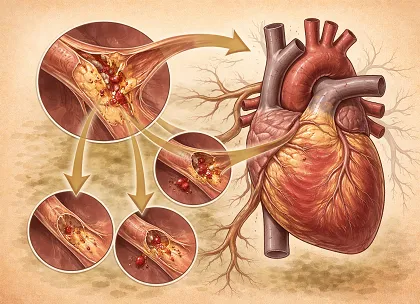
Heart doctors treating ST-segment elevation myocardial infarction (STEMI) patients often focus on the culprit lesion during emergency procedures, but a new study reveals that plaque ruptures in other coronary arteries carry important long-term warnings.
Researchers used optical coherence tomography (OCT) to examine all three coronary vessels in STEMI patients before their intervention, identifying non-culprit plaque ruptures and non-ruptured thin-cap fibroatheroma (TCFA) lesions. The study published in the Eurointervention included 930 STEMI patients with 3,660 non-culprit lesions, finding non-culprit plaque rupture in 165 patients and 209 lesions, while non-ruptured TCFA appeared in 214 patients and 281 lesions. Follow-up lasted a median of 4.1 years, tracking major adverse cardiac events (MACE) such as cardiac death, non-fatal myocardial infarction, and unplanned revascularization.
Patient-Level Risk Rises with Non-Culprit Ruptures
Patients who had any non-culprit plaque rupture showed significantly higher rates of MACE compared to those without such findings, with a hazard ratio of 2.25 (95% CI 1.13-4.49, p=0.021). This indicates that pancoronary vulnerability, marked by ruptures away from the main blockage, doubles the risk of future heart events over time. Clinicians treating acute STEMI cases should consider full 3-vessel OCT imaging to uncover these hidden threats, as they point to widespread instability that standard angiography might miss.
Lesion-Level Analysis Shifts Focus to TCFA
At the individual lesion level, non-culprit plaque rupture did not independently predict higher MACE rates (HR 0.05, 95% CI 0.00-24.68, p=0.336), suggesting that these ruptures serve more as markers of overall patient risk rather than direct triggers for future problems. Multivariable analysis further clarified that non-ruptured TCFA lesions strongly associated with subsequent MACE at both patient and lesion levels, positioning TCFA as the true high-risk feature driving events. This finding guides intervention decisions toward vulnerable plaques with thin fibrous caps rather than healed ruptures.
Practical Shifts for Interventional Cardiologists
Interventional cardiologists can now prioritize TCFA lesions identified by OCT during STEMI cases, potentially using preventive stenting or aggressive medical therapy like high-dose statins and dual antiplatelet regimens to stabilize them. The study's real-world STEMI cohort demonstrates that non-culprit plaque rupture flags patients needing closer surveillance, while TCFA demands action to avert the next crisis. Long-term follow-up data reinforces the value of comprehensive plaque assessment beyond the acute phase.
Tailored Strategies Improve STEMI Survival
This research encourages heart teams to adopt routine 3-vessel OCT protocols in suitable STEMI patients, enabling personalized risk reduction that targets the real culprits of recurrence. Patients with non-ruptured TCFA benefit from intensified lipid control and lifestyle interventions, ultimately lowering MACE rates through precision care.
Featured
Off
Page Content
#ffffff
Anonymous user
On
Authenticated user
On
Premium
On
Paid / Sponsored
On
Key highlights
- Patients with non-culprit plaque rupture during STEMI face more than double the risk of major adverse cardiac events over 4.1 years compared to those without.
- Non-culprit plaque rupture at the lesion level does not independently predict future events, serving mainly as a patient-level risk marker.
- Non-ruptured thin-cap fibroatheroma (TCFA) lesions strongly associate with subsequent MACE at both patient and lesion levels in STEMI survivors.
- Optical coherence tomography of all three vessels reveals pancoronary vulnerability that standard angiography often misses in acute STEMI cases.
- Treatment should target non-ruptured TCFA lesions identified by OCT to reduce long-term cardiac event rates effectively.
Source
Zhao J, Zhao R, Chen Y, et al. Long-term clinical outcomes of non-culprit plaque rupture in STEMI. EuroIntervention. 2026 Jan 5;22(1):e32-e43. doi: https://doi.org/10.4244/EIJ-D-25-00648.
Thumbnail
Speciality
Currency
Sub Speciality
Sub Sub Speciality
Short Description
STEMI patients with non-culprit plaque ruptures face double the heart event risk over 4 years, but non-ruptured TCFA—not ruptures—drives lesions causing future trouble.
User Segments
Release Date
Featured Order
0
Is Paid
0
Send Notification
Off