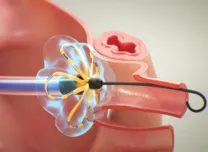
Scar-related ventricular tachycardia (VT) remains one of the most challenging substrates for catheter ablation because of thick, fibrotic myocardial scar. These findings were reported in Circulation from the first-in-human Ventricular Catheter Ablation Study (VCAS) evaluating pulsed field ablation.
The prospective study enrolled 26 patients with ischemic or nonischemic scar-related VT across two centers. The cohort had a mean age of 66 ± 9 years, 4% were women, mean left ventricular ejection fraction was 32 ± 10%, 42% presented with VT storm, and 42% had prior VT ablation. An investigational force-sensing pulsed field ablation (PFA) catheter delivered QRS-synchronized, high-voltage monophasic pulses. Study end points included procedural efficiency, safety, and effectiveness through 6 months of follow-up.
Acute procedural success was achieved in 92% of patients, with a median of 21 lesions per patient and a median ablation time of 31 minutes. Clinical VT was inducible in 88% of tested patients before ablation and in 6% after ablation (P < 0.001). High-density epicardial and endocardial voltage mapping was performed in 42% of patients. Among those undergoing endocardial-only PFA, 100% demonstrated transmural tissue homogenization.
Freedom from recurrent VT, ventricular fibrillation, or implantable cardioverter defibrillator shock was 81.8% during follow-up. VT and ventricular fibrillation burden declined by 98% compared with baseline (P < 0.001). Primary safety events within 180 days occurred in 11.5% of patients.