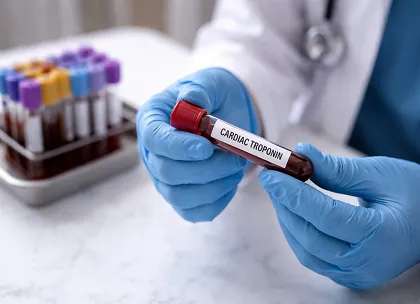
A newer high-sensitivity cardiac troponin T assay generation demonstrated diagnostic performance comparable to the current standard while identifying fewer patients with myocardial injury. A secondary analysis of an international, prospective diagnostic study with central adjudication, published in the Journal of the American College of Cardiology, evaluated the clinical performance of high-sensitivity cardiac troponin T generation 6 (hs-cTnT-gen6) in patients presenting with suspected myocardial infarction (MI) to the emergency department (ED).
A total of 3,346 patients were included, of whom 616 (18.4%) had a final diagnosis of MI. Both hs-cTnT-gen6 and hs-cTnT-gen5 were measured at identical time points, enabling direct comparison of analytical and diagnostic performance.
The proportion of patients classified as having myocardial injury, defined by concentrations above the upper reference limit, was significantly lower with hs-cTnT-gen6 (35.9%) compared with hs-cTnT-gen5 (43.5%; P < 0.001). Diagnostic accuracy at ED presentation was comparable between assays, with area under the curve values of 0.927 (95% CI: 0.918-0.937) for hs-cTnT-gen6 and 0.931 (95% CI: 0.921–0.940) for hs-cTnT-gen5.
For rule-out strategies, an hs-cTnT-gen6 cutoff <6 ng/L enabled exclusion of non-ST-segment elevation myocardial infarction (NSTEMI) in 30.0% of patients with 100% sensitivity (95% CI: 99.4%-100%). Optimized European Society of Cardiology (ESC) 0/1-hour and 0/2-hour algorithms further improved performance. Rule-out was achieved in up to 56.3% and 51.1% of patients with sensitivities of 99.7%. Rule-in thresholds (≥112 ng/L or delta changes ≥10 ng/L for 0/1-hour and ≥15 ng/L for 0/2-hour) demonstrated specificities of 93.4% and 92.7%. Findings were consistent across sensitivity analyses and external validation.
The hs-cTnT-gen6 assay showed comparable diagnostic accuracy with fewer patients labeled as myocardial injury. Assay-specific ESC algorithms enabled high sensitivity for rule-out and high specificity for rule-in.