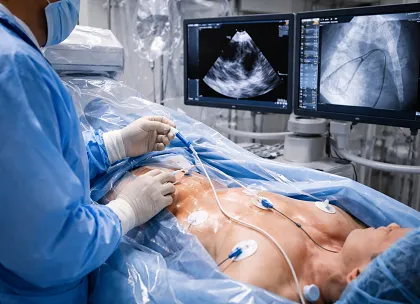
Selecting intraprocedural imaging for left atrial appendage occlusion (LAAO) in very elderly adults requires balancing procedural safety with long-term device-related outcomes. A real-world cohort study published in Circulation: Arrhythmia and Electrophysiology compared outcomes after intracardiac echocardiography (ICE)-guided and transesophageal echocardiography (TEE)-guided percutaneous LAAO in adults aged 80 years and older with atrial fibrillation.
The analysis used the TriNetX US Collaborative Network and included procedures performed between 2015 and 2025. After 1:1 propensity score matching for demographic and clinical characteristics, 2,913 patients were included in each group. Outcomes were evaluated through 7 days, 90 days, and 1 year using Cox proportional hazards models.
Findings
- At 90 days, mortality was similar between ICE- and TEE-guided procedures (HR 1.18; 95% CI 0.81-1.73).
- Stroke, device thrombosis, pericardial effusion, pericardiocentesis, tamponade, and device leak rates did not differ significantly at 90 days.
- At 1 year, mortality remained comparable between ICE- and TEE-guided procedures (HR 0.93; 95% CI 0.76-1.13).
- Stroke and device thrombosis rates also remained similar between groups during long-term follow-up.
- ICE-guided procedures corresponded with higher device leak incidence at 1 year compared with TEE-guided procedures (HR 1.81; 95% CI 1.11-2.97).
The analysis suggests that ICE- and TEE-guided LAAO achieved similar mortality, stroke, and device thrombosis outcomes in adults aged 80 years and older. Higher device leak rates observed with ICE guidance support the need for careful procedural technique and follow-up surveillance.