Intermediate Lesions Need Better Guidance
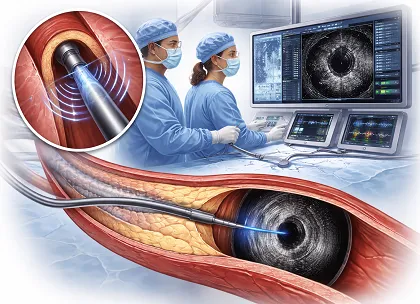
Cardiologists face uncertainty with 40-70% coronary stenoses daily. Angiography alone misses physiology and plaque details. Instantaneous wave-free ratio (iFR) measures pressure drops across lesions. Intravascular ultrasound (IVUS) shows vessel and plaque anatomy. This study published in the International Journal of Cardiology Research compares both head-to-head in real practice.
Small Prospective Trial Tests Both
Researchers enrolled 50 patients with intermediate stenosis needing stent consideration. Target vessels measured at least 2.5 mm in proximal to mid segments. Group I got iFR guidance. Group II received IVUS guidance. Everyone qualified for either test. Follow-up covered hospital stay, 30 days, and 6 months for MACE including death, non-fatal MI, or target lesion revascularization.
Baseline Groups Match Closely
Left ventricular ejection fraction showed no differences between groups. Angiographic findings appeared similar. Laboratory values stayed balanced. Procedural details including contrast use matched across both arms.
Outcomes Equal at Six Months
No MACE differences emerged at hospital discharge, 30 days, or 6 months. Primary and secondary endpoints stayed identical. Stent deployment success rates equaled. Both methods guided optimal PCI safely.
Radiation Favors iFR Approach
IVUS group absorbed higher radiation doses with p=0.019 statistical difference. iFR avoided extra imaging fluoroscopy time. Patient safety improved without losing guidance quality.
Choose Based on Lesion Questions
Use iFR first for hemodynamic doubt in intermediate lesions. Turn to IVUS for plaque burden or landing zone concerns. Both beat angiography alone for decision-making.
Hybrid Cath Lab Strategy Wins
Train fellows in both tools for complete assessment. iFR cuts radiation exposure in young patients. IVUS remains gold standard for complex anatomy.
Practice Ready for Either
Six-month data supports confidence in both approaches. Patient outcomes drive tool selection over tradition.
Featured
Off
Page Content
#ffffff
Anonymous user
On
Authenticated user
On
Premium
On
Paid / Sponsored
On
Key highlights
- Prospective single-center study compared iFR-guided PCI versus IVUS-guided PCI in 50 patients with intermediate coronary stenosis in vessels ≥2.5 mm proximally/mid.
- Baseline characteristics including LVEF, angiographic findings, and laboratory results showed no significant differences between iFR and IVUS guidance groups.
- In-hospital, 30-day, and 6-month MACE rates including death, non-fatal MI, and target lesion revascularization remained identical between both guidance strategies.
- Procedural contrast use and interventional details demonstrated no significant differences, but IVUS group received higher radiation dose (p=0.019).
- Both iFR physiological assessment and IVUS morphological evaluation provide equivalent clinical outcomes for intermediate lesion PCI guidance.
Source
Lotfy MA, Abd M, Ayman Mohamed El-Saied, Elsetiha MA, Badr SF. Comparison of instantaneous wave-free ratio and intravascular ultrasound-guided intervention strategy for clinical outcomes in patients with intermediate coronary stenosis. International Journal of Cardiology Research. 2026;8(1):01-09. doi: https://doi.org/10.33545/26634104.2026.v8.i1a.81
Thumbnail
Speciality
Currency
Sub Speciality
Sub Sub Speciality
Short Description
Single-center study of 50 patients with intermediate stenosis finds iFR-guided PCI equals IVUS-guided outcomes at 6 months, but uses less radiation (p=0.019).
User Segments
Release Date
Featured Order
0
Is Paid
0
Send Notification
Off