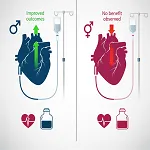
A new analysis from the FAIR-HF2-DZHK05 trial in European Journal of Heart Failure revealed significant sex-related differences in the effectiveness of intravenous iron therapy in patients diagnosed with heart failure and iron deficiency. While men experienced a clear benefit from treatment with ferric carboxymaltose, women showed no significant improvement.
The trial included 1,105 patients with heart failure and reduced ejection fraction (≤45%) and iron deficiency. The researchers randomized the participants to receive either intravenous ferric carboxymaltose or a placebo. Of the total, 368 were women (mean age: 68.7 years) and 737 were men (mean age: 70.5 years).
The primary outcomes evaluated were (1) time to cardiovascular death or first heart failure hospitalization, (2) total heart failure hospitalizations, and (3) time to first event of cardiovascular death or hospitalization in patients with transferrin saturation <20%.
In men, the therapy significantly reduced cardiovascular events. The hazard ratio (HR) for the first outcome was 0.74 (95% CI: 0.57–0.95; p = 0.016), while for the third outcome it was 0.73 (95% CI: 0.55–0.97; p = 0.028). However, in women, the HRs were 1.07 (p = 0.80) and 1.21 (p = 0.58), respectively, showing no meaningful benefit.
Although not statistically significant, there was an increased all-cause mortality in women receiving iron (HR: 1.46; p = 0.24) in contrast to a lower, non-significant HR of 0.86 in men.