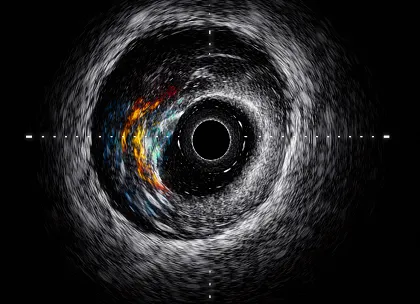
Intravascular ultrasound (IVUS)-guided percutaneous coronary intervention (PCI) has been associated with improved clinical outcomes compared with angiography-guided PCI; however, its role in complex bifurcation lesions treated with the double kissing (DK) crush technique has remained uncertain.
This multicenter, randomized, open-label trial, published in the Journal of American College of Cardiology, conducted across 24 centers in China evaluated the comparative effectiveness of IVUS-guided PCI versus angiography-guided PCI in such patients. Individuals with clinical indications for PCI and complex coronary bifurcation lesions defined by DEFINITION criteria, particularly side branch lesion length ≥10 mm, were included and randomized in a 1:1 ratio.
A total of 555 patients were assigned to IVUS-guided PCI (n=277) or angiography-guided PCI (n=278). DK crush was used in 96.8% of procedures, and approximately 44% of patients in each group had left main coronary artery involvement.
The primary endpoint was target vessel failure (TVF), defined as a composite of cardiac death, target vessel myocardial infarction (TVMI), or clinically driven target vessel revascularization at 1 year. At 1-year follow-up, TVF occurred in 6.1% of the IVUS-guided group compared with 14.7% of the angiography-guided group (hazard ratio 0.40; 95% CI, 0.23–0.71; P=0.002).
The reduction in events was primarily driven by lower rates of TVMI and target vessel revascularization. Findings suggest that outcome benefits were largely related to achieving IVUS-defined optimization targets rather than IVUS use alone.
IVUS-guided PCI demonstrated lower rates of composite adverse events at 1 year. Benefits were associated with procedural optimization guided by IVUS criteria.