The Scale of the Problem
In the study published in the European Journal of Preventive Cardiology, researchers pooled data from studies tracking adults ≥18 years over 1–20 years, using rigorous random-effects modeling in RevMan 5.4. This is not small-cohort epidemiology; these are population-level signals from millions living near major airports.
The study found an odd ratio (OR) of 1.10 (95% CI 1.07–1.14, P<0.001) for overall CVD risk, OR of 1.14 (95% CI 1.04–1.26, P=0.006) for night-time exposure, OR of 1.07 (95% CI 1.01–1.13, P=0.02) for CVD mortality, and OR of 1.07 (95% CI 1.02–1.12, P=0.009) for Myocardial infarction mortality.
Night-Time Exposure: The Sleep Disruption Signal
The strongest clinical signal emerged from night-time aircraft noise, where the CVD risk increase reached 14%. This aligns with growing evidence that nocturnal noise disrupts sleep architecture, elevates sympathetic tone, and triggers vascular inflammation—pathophysiologic mechanisms familiar to cardiologists managing hypertension and acute coronary syndromes.
For physicians, this creates a clear patient history question: "Do you live near an airport with regular night flights?" The OR of 1.14 suggests this environmental exposure may warrant consideration alongside traditional risk factors in risk calculators.
Blood Pressure: An Early Warning Sign
Aircraft noise showed a statistically significant elevation in systolic blood pressure (MD = 1.83 mmHg, P=0.04), representing a subtle but population-meaningful shift. Notably, hypertension risk appeared sex-specific with OR of 1.42 in males and OR of 1.01 in females. While overall hypertension OR was nonsignificant (1.02, P=0.74), the male-specific signal suggests possible sex differences in vascular or autonomic responses to chronic noise stress.
Mortality Patterns: What Kills, What Doesn't
The mortality associations showed a clear gradient with a significant increase in the CVD mortality (OR: 1.07) and MI mortality (OR: 1.07), and non-significant ischemic heart disease mortality (OR: 1.05) and stroke mortality (OR: 1.01). This pattern suggests aircraft noise may preferentially impact coronary physiology through mechanisms like endothelial dysfunction, microvascular rarefaction, or platelet hyper-reactivity rather than large-vessel cerebrovascular disease.
Clinical Implications: What Physicians Should Do
For primary care physicians and cardiologists, routine history taking should incorporate proximity to major airports or flight paths, frequency of night-time aircraft exposure, and bedroom orientation relative to noise sources. In risk stratification, aircraft noise should be viewed as a continuous risk enhancer, particularly in men with borderline hypertension, individuals with predominant nocturnal exposure, and patients with existing coronary risk factors.
Patient counseling should therefore include practical noise-mitigation strategies (such as white-noise devices, earplugs, or bedroom relocation), emphasis on sleep hygiene, and, for high-risk individuals living directly under flight paths, discussion of longer-term relocation options.
Environmental cardiology just became everyone's problem. The next time a patient mentions living near the airport, the appropriate response is no longer "interesting"—it's "clinically relevant."
Featured
Off
Page Content
#ffffff
Anonymous user
On
Authenticated user
On
Premium
On
Paid / Sponsored
On
Key highlights
- Significant association exists between aircraft noise exposure and increased risk of cardiovascular events and mortality.
- Night-time exposure demonstrates a stronger association with cardiovascular risk.
- Systolic blood pressure increases and higher hypertension risk in males indicate early cardiovascular effects.
- Sex-specific effects are suggested by the differential hypertension risk patterns.
- Mitigating chronic aircraft noise exposure is important to reduce long-term cardiovascular burden.
Source
Sebastian SA, Sethi Y, Johal G. Association between long-term aircraft noise exposure and cardiovascular disease: a meta-analysis with focused subgroup analyses. Eur J Prev Cardiol. 2025 Dec 23;32(18):1943-1959. doi: https://doi.org/10.1093/eurjpc/zwaf471.
Thumbnail
Speciality
Currency
Sub Speciality
Sub Sub Speciality
Short Description
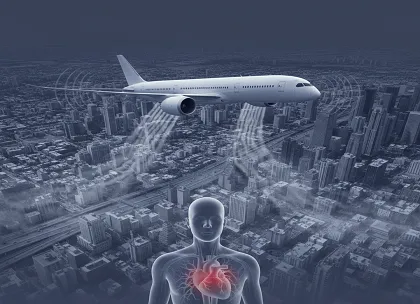
A comprehensive meta-analysis spanning 34 studies and nearly 35.5 million adults finds that chronic exposure to aircraft noise increases the risk of cardiovascular disease by 10%, with nighttime exposure showing even stronger effects.
User Segments
Release Date
Featured Order
0
Is Paid
0
Send Notification
Off