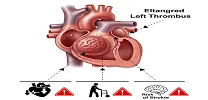
A new multicenter retrospective study published in HeartRhythm has identified three key factors that significantly increase the risk of thromboembolic events in patients diagnosed with left atrial thrombi (LATs). These findings may help guide more effective risk stratification and inform treatment decisions for this high-risk population.
The study, which analyzed data from 206 patients across 15 centers, followed participants for a median of 651 days (interquartile range: 174–1316 days) after their LAT was confirmed via echocardiography. During this period, 19 patients (9.2%) experienced symptomatic thromboembolic events.
The study identified three independent predictors of thromboembolism: maximum LAT length greater than 20 mm (HR 2.63; 95% CI 1.03–6.68; P=0.043), left ventricular ejection fraction (LVEF) ≤40% (HR 2.95; 95% CI 1.14–7.63; P=0.026), and presence of thrombus mobility (HR 3.40; 95% CI 1.27–9.11; P=0.015).
Patients were stratified into two groups based on these factors. Of the 206 patients, 52 (25.2%) were categorized as high risk (having two or more of these predictors), while 154 (74.8%) were considered low risk. The high-risk group demonstrated a markedly higher incidence of thromboembolism compared to the low-risk group (23.1% vs. 4.5%; P<0.001), despite a significantly greater proportion undergoing urgent surgical thrombectomy (UST) (17.3% vs. 5.8%; P=0.025).
Within the high-risk group, patients who received UST experienced significantly fewer adverse clinical outcomes, such as all-cause mortality, heart failure hospitalization, major bleeding, or further thromboembolic events, at 90 days, compared to those who did not undergo surgery (0% vs. 35.6%; log-rank P=0.048).