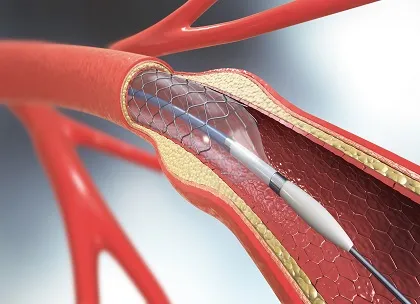
Severely calcified coronary lesions are associated with higher procedural risk during percutaneous coronary intervention (PCI). In this international, assessor-blinded randomized trial, patients with severely calcified coronary lesions undergoing PCI were assigned to lesion preparation with lithotripsy or conventional techniques prior to stent implantation. A total of 200 patients were randomized: 99 to lithotripsy and 101 to conventional preparation. The study was published in the JACC: Cardiovascular Interventions.
The primary composite endpoint included procedural failure (failed or no stent delivery, or residual area stenosis ≥20% by optical coherence tomography) or target vessel failure (cardiac death, myocardial infarction, or clinically driven revascularization) at 1 year.
The primary endpoint occurred in 35 patients (35%) in the lithotripsy group compared with 52 patients (52%) in the conventional group (risk ratio [RR] 0.69; 95% confidence interval [CI] 0.48–0.97; P=0.02). Residual area stenosis ≥20% was the most frequent component, occurring in 32 patients (32%) versus 45 patients (45%), respectively (RR 0.73; 95% CI 0.49–1.04). Safety endpoints did not differ between groups.
This randomized trial showed a lower combined incidence of procedural failure or target vessel failure at 1 year with lithotripsy. The reduction was primarily driven by lower rates of residual area stenosis ≥20%.