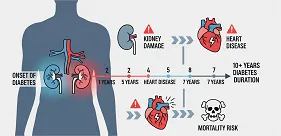
A large study published in the World Journal of Diabetes has found that both the length of time a person has type 2 diabetes and their kidney function independently increase the risk of heart attack, stroke, and death. The risks significantly increase when the two factors occur together.
Researchers analyzed data from more than 2.1 million adults with diabetes aged 20 years and older. The data was obtained from the Korean National Health Insurance Service. Participants were grouped by diabetes duration into new-onset, under 5 years, 5–9 years, or 10 years or more, and kidney function levels. The group with new-onset diabetes and normal eGFR (≥90 mL/min/1.73 m²) was the reference.
The average follow-up time was 3.9 years. The study reported 36,003 myocardial infarctions (MIs), 46,496 ischemic strokes (ISs), and 73,549 deaths during the follow-up period. Both longer diabetes duration and lower eGFR were linked to higher risks of MI, IS, and mortality. These risks were further elevated when the two factors coexisted.
Even people with newly diagnosed diabetes had higher MI and IS risk if kidney function was mildly reduced (60–90 mL/min/1.73 m²). Mortality risk rose sharply when eGFR fell below 60 mL/min/1.73 m², especially in those with a longer history of diabetes.