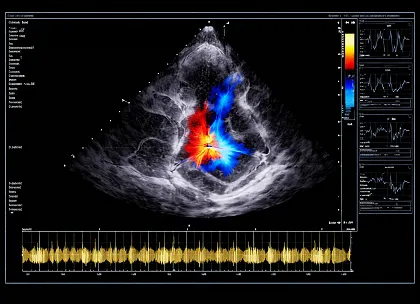
Mitral annular calcification-related mitral stenosis is increasingly recognized in aging populations and has been associated with elevated mortality risk. The Japan Multicenter Mitral Annular Calcification (JAMAC) study examined long-term outcomes and valve-related prognostic factors in this condition.
This retrospective multicenter study published in the Journal of the American College of Cardiology included adult patients from 11 Japanese centers who underwent echocardiography between 2016 and 2017 and demonstrated MAC with a transmitral mean gradient ≥5 mm Hg. Echocardiographic parameters included mitral valve area (MVA), presence of anterior MAC on parasternal long-axis imaging, and grading of posterior MAC based on the extent of the posterior annular circumference on parasternal short-axis view. Posterior MAC severity was categorized as mild (<1/3), moderate (1/3–2/3), or severe (>2/3).
A total of 264 patients were included (median age 78 years; 73% female). Calcific MS accounted for 76% of cases, while 24% had rheumatic MS. Median MVA was 1.40 cm² and mean transmitral gradient was 6.1 mm Hg. Anterior MAC was present in 63%, and posterior MAC was severe in 47% and moderate in 25%. Five-year survival was 57%. Cardiac mortality occurred in 16% and noncardiac mortality in 24% of patients. Mortality rates were higher in calcific MS compared with rheumatic MS (cardiac death 18% vs 11%; noncardiac death 28% vs 13%). Anterior MAC and severe posterior MAC were associated with increased mortality. An MVA <1.5 cm² predicted mortality in calcific MS, and MVA remained independently associated with mortality in multivariable analysis (adjusted HR 1.56; 95% CI 1.03–2.38).
MAC-related MS was associated with substantial mortality over five years, with overall survival of 57%. Severity of mitral stenosis and extent of annular calcification were associated with long-term outcomes.