Chronic kidney disease progression remains a leading cause of morbidity despite recent therapeutic advances, with sodium-glucose cotransporter-2 inhibitors establishing renoprotective efficacy through hemodynamic and tubular mechanisms. Metformin utilization in moderate chronic kidney disease carries historical safety concerns but recent pharmacovigilance data support its application when eGFR exceeds 30 mL/min/1.73m².
This 12-month randomized controlled trial published in the Diabetology & Metabolic Syndrome enrolled 120 patients with moderate chronic kidney disease, stratifying them into three parallel arms: metformin 1000 mg daily, empagliflozin 10 mg daily, or standard care continuation, each added to background renin-angiotensin system blockade.
Primary outcome focused on estimated glomerular filtration rate trajectory, with secondary endpoints capturing urinary albumin-to-creatinine ratio, transforming growth factor-β1, kidney injury molecule-1, and beclin-1 as markers of fibrosis, tubular injury, and autophagy regulation. Investigators monitored metabolic parameters and adverse events systematically throughout follow-up.
eGFR Preservation Demonstrates Therapeutic Equivalence
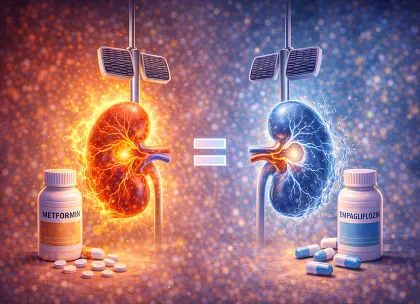
One hundred eighteen patients completed protocol with balanced baseline characteristics across arms. Both metformin and empagliflozin significantly attenuated eGFR decline versus control, achieving adjusted mean differences of 8.91±1.92 mL/min/1.73m² (P<0.001) and 5.1±1.89 mL/min/1.73m² (P=0.03), respectively. Exploratory subgroup analysis revealed metformin's superior eGFR stabilization in non-diabetic chronic kidney disease patients, suggesting diabetes-independent antifibrotic mechanisms.
Mechanistic Differentiation Through Biomarker Trajectories
Urinary albumin-to-creatinine ratio reduction occurred with both agents versus control, confirming antiproteinuric consistency. Metformin uniquely attenuated transforming growth factor-β1 elevation by 28.8% (95% CI -44.4 to -9, P=0.003) and enhanced beclin-1 expression by 179.3% (95% CI 32.2 to 490, P=0.003), supporting antifibrotic and pro-autophagy effects. Empagliflozin selectively reduced kidney injury molecule-1 by 29% (95% CI -49.3 to -0.5, P=0.045), preserving tubular integrity through established mechanisms.
Favorable Metabolic Profile Without Urate Perturbation
Lipid parameters improved across active treatment arms without significant urate alterations. Adverse event profiles proved comparable, with empagliflozin-associated increased urination frequency remaining clinically tolerable.
Strategic Repositioning of Metformin in CKD Management
Nephrologists and endocrinologists gain evidence supporting metformin as viable renoprotective alternative to SGLT2 inhibitors, particularly among non-diabetic moderate chronic kidney disease patients where fibrosis predominates. Mechanistic complementarity suggests potential combination strategies targeting parallel pathogenic pathways. Routine eGFR preservation alongside biomarker monitoring enhances precision chronic kidney disease care while expanding therapeutic armamentarium beyond costlier agents.
Featured
Off
Page Content
#ffffff
Anonymous user
On
Authenticated user
On
Premium
On
Paid / Sponsored
On
Key highlights
- Metformin preserves eGFR with adjusted mean difference 8.91±1.92 mL/min/1.73m² (P<0.001) and empagliflozin 5.1±1.89 (P=0.03) versus standard care over 12 months.
- Metformin demonstrates superior eGFR stabilization among non-diabetic CKD patients compared to empagliflozin.
- Metformin reduces TGF-β1 by 28.8% (P=0.003) and increases beclin-1 by 179.3% (P=0.003), supporting antifibrotic/autophagy effects.
- Empagliflozin selectively lowers KIM-1 by 29% (P=0.045), confirming tubular protection.
- Both agents exhibit comparable safety profiles with favorable lipid effects versus control.
Source
Mahboub BM, Refaie AF, El-Haggar SM, Hafez YM, Mostafa TM. Efficacy and safety of metformin versus empagliflozin on chronic kidney disease progression (MET-EMPA-CKD): a randomized controlled trial. Diabetol Metab Syndr. 2025 Dec 10;18(1):17. doi: https://doi.org/10.1186/s13098-025-02040-9
Thumbnail
Speciality
Currency
Sub Speciality
Sub Sub Speciality
Short Description
Twelve-month RCT demonstrates metformin 1000 mg/day preserves eGFR comparably to empagliflozin 10 mg/day versus standard care in 120 moderate CKD patients, with metformin superior in non-diabetics.
User Segments
Release Date
Featured Order
0
Is Paid
0
Send Notification
Off