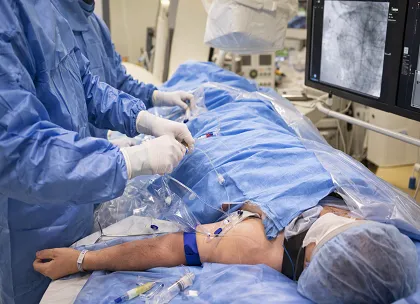
Concerns regarding bleeding persist with microaxial flow pump (mAFP) despite improved outcomes in selected patients with ST-segment elevation myocardial infarction and cardiogenic shock (STEMI-CS). Investigators analyzed bleeding outcomes in the international, multicenter randomized DanGer Shock trial. The analysis results were published in the JACC: Cardiovascular Interventions.
A total of 355 patients with STEMI-CS were randomized to mAFP (n=179) or standard care (n=176). Major bleeding was defined as Bleeding Academic Research Consortium (BARC) type 3–5 events. Over a median follow-up of 121 days (Q1–Q3: 3–180), BARC 3–5 bleeding occurred in 47 patients (26.3%; 95% CI 20.3%–33.2%) in the mAFP group compared with 27 patients (15.3%; 95% CI 10.7%–21.4%) receiving standard care (P<0.001).
Among 210 patients treated with any mechanical circulatory support (MCS), 74 bleeding events were observed: 2 (2.7%) occurred in the catheterization laboratory, 35 (47.3%) during MCS support, and 37 (50.0%) after device removal. Bleeding risk increased with device complexity.
ompared with no device, odds ratios for BARC 3–5 bleeding were 4.94 (95% CI 2.30–10.65) for mAFP, 8.06 (95% CI 2.81–23.09) for VA-ECMO, and 27.40 (95% CI 9.82–76.43) for combined mAFP+VA-ECMO (all P<0.001). Multivariable analysis identified mAFP use, escalation to VA-ECMO and renal replacement therapy as independent predictors.
Patients randomized to mAFP experienced higher rates of major bleeding than those receiving standard care. Bleeding frequency increased with mechanical support complexity, with half of events occurring after device removal.