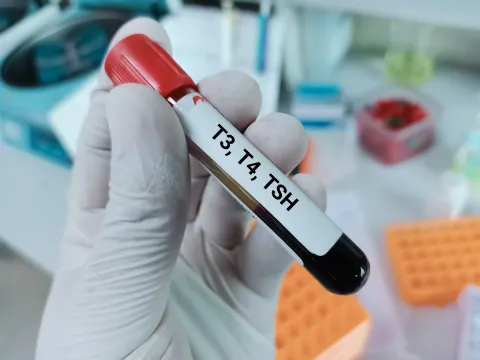
Interactions between thyroid function and glucose metabolism may influence glycemic control in people with type 2 diabetes mellitus (T2DM). A retrospective study published in the Journal of Diabetes evaluated potential nonlinear relationships between thyroid hormones and glycemic control indicators.
Electronic medical records from a tertiary care hospital in Chengdu, Sichuan Province, were analyzed. The study included 1,413 patients with T2DM treated between 2018 and 2023. Restricted cubic spline regression and threshold effect analyses were used to assess associations between free triiodothyronine (FT3), free thyroxine (FT4), thyroid-stimulating hormone (TSH), and glycated hemoglobin (HbA1c).
The analysis showed a nonlinear relationship between FT3 and HbA1c (p for nonlinearity <0.05). Threshold analysis did not identify a statistically significant inflection point for FT3. For values below 5.92 pmol/L, the association with HbA1c was β = 0.008 (95% CI −0.122 to 0.281), while above 5.92 pmol/L the estimate was β = −0.109 (95% CI −0.261 to 0.042).
A nonlinear association between FT4 and HbA1c was also identified (p for nonlinearity <0.05), with an inflection point at 14.82 pmol/L. Below this threshold, each 1 pmol/L increase in FT4 corresponded to a 0.263% increase in HbA1c (β = 0.263, 95% CI 0.189-0.337). Similarly, TSH showed a nonlinear association with HbA1c (p for nonlinearity <0.05), with an inflection point at 5.53 mIU/L. When TSH values were below this level, each 1 mIU/L increase corresponded to a 0.179% reduction in HbA1c (β = −0.179, 95% CI −0.281 to −0.076). These findings describe nonlinear associations between thyroid function markers and glycemic control in patients with T2DM.