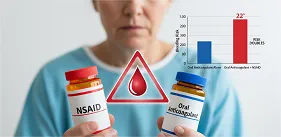
An extensive nationwide study in the European Heart Journal-Quality of Care and Clinical Outcomes has found that non-steroidal anti-inflammatory drugs (NSAIDs) use significantly enhances the bleeding risk in patients on oral anticoagulants for venous thromboembolism (VTE).
The study analyzed data from 51,794 patients who began treatment with oral anticoagulants for VTE between 2012 and 2022. Researchers assessed the relationship between NSAID use and hospital-diagnosed bleeding events.
Bleeding rates were nearly doubled during periods of NSAID use, i.e., 6.3 events per 100 person-years compared to 3.5 during periods of non-use. The adjusted hazard ratio (HR) for any bleeding associated with NSAID use was 2.09.
When individual NSAIDs were analyzed, the bleeding risk remained high. Ibuprofen, diclofenac, and naproxen have HRs of 1.79, 3.30, and 4.10, respectively.
The bleeding risk was not limited to the gastrointestinal tract. Compared to non-use, NSAID use was associated with a two- to three-fold higher risk of gastrointestinal bleeding (HR 2.24), intracranial bleeding (HR 3.22), and anemia caused by bleeding (HR 2.99). Although the risk for thoracic, respiratory, and urinary tract bleeding was less pronounced, the study reported an elevated risk.