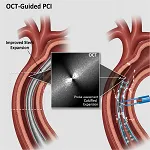
A landmark randomized trial has shown that using optical coherence tomography (OCT) to guide stent placement in patients with calcified coronary lesions significantly improves stent expansion compared to traditional angiography, without increasing procedural risks. The findings were published in JAMA Cardiology.
The CALIPSO trial (Calcified Lesion Intervention Planning Steered by OCT), conducted across 12 medical centers in France between December 2021 and June 2023, is the first study to directly compare OCT and angiography guidance for percutaneous coronary intervention (PCI) in this challenging patient population. Researchers analyzed the data between December 2023 and April 2024.
The prospective, open-label trial included 134 patients with stable, moderately to severely calcified coronary lesions scheduled for PCI. The researchers randomly assigned the participants to either OCT-guided or angiography-guided PCI. The OCT group followed a standardized algorithm for lesion assessment and preparation, and all patients received post-PCI OCT imaging for evaluation.
The primary outcome, the minimal stent area (MSA), was significantly larger in the OCT group, with a median MSA of 6.5 mm² compared to 5.0 mm² in the angiography group (P < .001).
There was a higher use of intravascular lithotripsy in the OCT group (46% vs. 12%). The researchers reported no differences in procedural safety outcomes, e.g., periprocedural myocardial infarction, contrast volume, radiation exposure, or procedure duration.