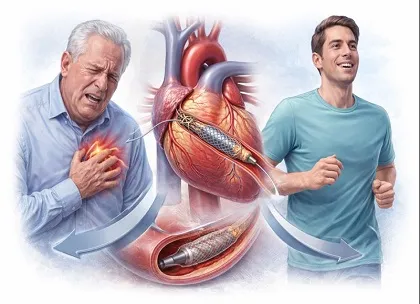
PCI works better for symptom relief in older patients with stable angina, according to a new look at ORBITA-2 trial data. This sham-controlled study first proved PCI's value without antianginal drugs. Researchers now checked how age affects results. The results were published in the Journal of American College of Cardiology.
Trial Setup and Patient Details
The ORBITA-2 trial included patients aged 40 to 82 years, with a mean age of 64 ± 9 years. All had stable angina and single- or multivessel disease. This post-hoc analysis used data from all participants. Bayesian models assessed daily symptoms, treadmill time, stress echo, and questionnaires. Age interacted with treatment effects on key endpoints.
Symptom Relief Favors Older Patients
Older patients saw stronger angina relief from PCI. The odds ratio reached 2.03 (95% CrI: 1.67-2.45; Pr > 0.99) in older groups. Younger patients had an OR of 1.70 (95% CrI: 1.38-2.15; Pr > 0.99). The interaction probability was 0.99. Age showed little link to baseline symptom or stenosis severity.
Exercise Gains Stronger in Youth
PCI improved treadmill exercise time more in younger patients. A 50-year-old gained +125 s (95% CrI: 35.8-215.0 s; Pr > 0.99). A 70-year-old gained just +31.9 s (95% CrI: −12.6 to 78.3; Pr = 0.92). Interaction probability hit 0.96. This questions treadmill time as a top endpoint in elderly-focused trials.
Implications for Practice and Trials
PCI cut angina frequency in all ages. Limited exercise gains in elderly challenge its trial use. These results push for age-inclusive trial designs in cardiology. Doctors can use this to set patient expectations on PCI outcomes.
Featured
Off
Page Content
#ffffff
Anonymous user
On
Authenticated user
On
Premium
On
Paid / Sponsored
On
Key highlights
- PCI effectively reduces angina frequency across all age groups in stable angina patients from ORBITA-2.
- Older patients experience greater symptom relief from PCI, with an OR of 2.03 compared to 1.70 in younger patients.
- Younger patients, like those aged 50, gain more treadmill exercise time (+125 s) from PCI than older ones (+31.9 s at age 70).
- Age has little connection to baseline symptom severity or stenosis in this cohort.
- Trial designers should rethink treadmill exercise as a primary endpoint due to weak elderly responses.
Source
Simader, F, Rajkumar, C, Foley, M. et al. Association Between Age and PCI Effectiveness in Stable CAD: Secondary Analysis of ORBITA-2. JACC. 2026 Jan, 87 (3) 253–265. https://doi.org/10.1016/j.jacc.2025.10.086
Thumbnail
Speciality
Currency
Sub Speciality
Sub Sub Speciality
Short Description
ORBITA-2 post-hoc analysis reveals PCI eases angina symptoms across all ages in stable angina patients, but boosts exercise time more in younger ones. These findings guide trial designs for broader applicability.
User Segments
Release Date
Featured Order
0
Is Paid
0
Send Notification
Off