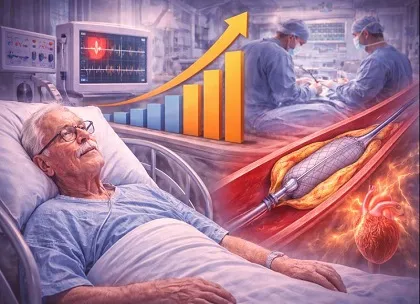
Nonagenarians represent fastest-growing U.S. demographic. They face high NSTEMI burden. PCI utilization and outcomes remain unclear in this group. In the study published in the American Journal of Cardiology, the researchers analyzed 122,845 NSTEMI hospitalizations from 2015-2019. Data came from National Inpatient Sample. They compared PCI (8% of cases) versus medical management (92%). Medical management cases dropped 18% over study period (p=0.04). PCI use rose from 7% to 9% (p=0.03).
Medical Management Carries Higher Comorbidity Burden
Medical management patients had higher Elixhauser comorbidity scores (p<0.001). They showed higher 30-day readmission scores (p<0.001). In-hospital mortality scores were also higher (p<0.001). In-hospital mortality reached 7.9% versus 4.2% for PCI (p<0.001).
Mortality Predictors Differ by Treatment Strategy
Medical management mortality linked most to alcohol abuse. Chronic blood loss anemia strongly predicted death. Diabetes also associated with higher risk in this group. PCI mortality correlated with inotrope/vasopressor use. Chronic pulmonary disease increased PCI mortality risk. Prior transient ischemic attack predicted worse PCI outcomes. Peripheral vascular disease showed strongest PCI mortality association.
Individualized Approach Essential for Nonagenarians
PCI demonstrates lower in-hospital mortality benefit. Utilization remains under 10% nationally. Distinct comorbidity profiles exist between treatment groups. Mortality predictors vary significantly by strategy. Cardiologists need individualized risk assessment for nonagenarians. Age alone should not preclude PCI consideration. Heart team discussions optimize revascularization decisions. Frailty and comorbidity burden guide therapy selection over chronologic age alone. Rising PCI adoption reflects evolving evidence supporting invasive strategy even among vulnerable elderly.
Featured
Off
Page Content
#ffffff
Anonymous user
On
Authenticated user
On
Premium
On
Paid / Sponsored
On
Key highlights
- PCI utilization in nonagenarian NSTEMI increased from 7% to 9% (2015-2019) while medical management dropped 18%.
- Medical management shows 7.9% in-hospital mortality versus 4.2% for PCI with higher Elixhauser comorbidity scores.
- Medical management mortality links to alcohol abuse, chronic blood loss anemia, and diabetes.
- PCI mortality correlates with inotrope use, chronic pulmonary disease, prior TIA, and peripheral vascular disease.
- Individualized treatment strategies required beyond age-based exclusion for nonagenarian NSTEMI management.
Source
Kim M, Priyesh Thakurathi, Nagpal J, et al. Outcomes and Predictors of In-hospital Mortality in Nonagenarians with NSTEMI: A Comparison of PCI and Medical Management. The American Journal of Cardiology. 2025;260:36-43. doi: https://doi.org/10.1016/j.amjcard.2025.11.016
Thumbnail
Speciality
Currency
Sub Speciality
Sub Sub Speciality
Short Description
National Inpatient Sample analysis of 122,845 nonagenarian NSTEMI cases shows PCI use increased from 7% to 9% (2015-2019) with 4.2% versus 7.9% in-hospital mortality versus medical management.
User Segments
Release Date
Featured Order
0
Is Paid
0
Send Notification
Off