Cuffless Monitors Need Pediatric Validation
Children grow fast and change body size yearly. Cuffless blood pressure devices promise continuous tracking but struggle with growth. Pulse arrival time works in adults but confounds in kids. This study tests pulse arrival velocity as better solution. The results were published in the Heart, Lung and Circulation.
Bruce Protocol Stresses Young Hearts
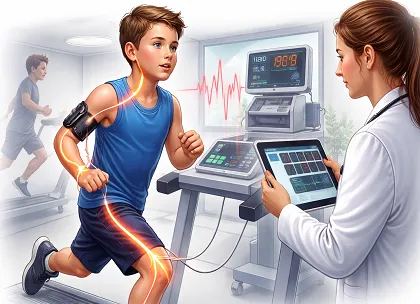
Researchers studied 38 pediatric patients aged 12.3 plus or minus 3.9 years during Bruce protocol exercise testing. They measured pulse arrival time and calculated pulse arrival velocity as distance divided by PAT. Regression models and leave-one-out validation tested exercise BP change prediction. Association for Advancement of Medical Instrumentation standards guided accuracy goals.
Systolic Tracking Hits Gold Standard
Exercise raised systolic BP by 36.1 plus or minus 15.8 mmHg across participants. PAT models estimated changes with error 0.0 plus or minus 9.1 mmHg. PAV models improved accuracy to 0.0 plus or minus 7.6 mmHg meeting AAMI criteria of 5 plus or minus 8 mmHg. Correlation reached r equals 0.87 for PAV.
Diastolic Shows Promise But Weaker
Diastolic BP rose 12.1 plus or minus 9.7 mmHg with exercise. PAV estimation error measured 0.0 plus or minus 7.0 mmHg also within AAMI standards. Correlation stayed modest at r equals 0.51. Heart rate, age, sex, or height added no benefit.
Growth Changes Demand Distance Adjustment
PAV fixes PAT weakness by including heart to sensor distance mathematically. Growth alters propagation length yearly in children. Cuffless watches and patches need PAV algorithms for accuracy.
Pediatric Cardiology Gets Wearables
Sports clearance and hypertension screening improve with reliable exercise BP. PAV enables true ambulatory monitoring in active kids. Validation trials should follow quickly.
Clinical Use Starts Now
Order PAV-enabled devices for high-risk pediatric patients. Exercise stress testing validates performance before routine adoption.
Featured
Off
Page Content
#ffffff
Anonymous user
On
Authenticated user
On
Premium
On
Paid / Sponsored
On
Key highlights
- Researchers tested PAT and PAV for exercise BP tracking in 38 children aged 12.3±3.9 years undergoing Bruce protocol stress testing with leave-one-out cross-validation.
- Systolic BP increased 36.1±15.8 mmHg with exercise; PAV estimation error measured 0.0±7.6 mmHg meeting AAMI criteria (5±8 mmHg) with correlation r=0.87.
- Diastolic BP rose 12.1±9.7 mmHg; PAV showed AAMI-compliant error of 0.0±7.0 mmHg but modest correlation r=0.51.
- Adding heart rate, age, sex, or height did not improve PAV model performance over simple distance-adjusted calculation.
- PAV outperforms PAT for systolic BP tracking during exercise by accounting for growth-related pulse propagation distance variability in children and adolescents.
Source
Ryan LE, Clarke MM, Ray D, et al. Pulse Arrival Velocity for Tracking Exercise-Induced Blood Pressure Changes in Children and Adolescents. Heart, Lung and Circulation. 2026;35(1):74-81. doi: https://doi.org/10.1016/j.hlc.2025.09.005
Thumbnail
Speciality
Currency
Sub Speciality
Sub Sub Speciality
Short Description
Pediatric study of 38 children finds PAV estimates exercise systolic BP changes within AAMI criteria (error 0.0±7.6 mmHg, r=0.87), outperforming PAT by accounting for growth-related distance.
User Segments
Release Date
Featured Order
0
Is Paid
0
Send Notification
Off