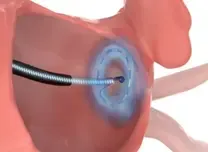
The need to reduce post-ablation inflammation has increased interest in nonthermal approaches for pulmonary vein isolation. A study published in the International Journal of Cardiology compared inflammatory and myocardial injury responses after pulmonary vein isolation performed with radiofrequency catheter ablation (RFCA), CBA, and PFA in paroxysmal atrial fibrillation.
The analysis enrolled 313 individuals: 109 underwent RFCA, 110 underwent CBA, and 93 underwent PFA. The PFA cohort included 54 procedures using a focal-electrode configuration and 39 procedures using a multi-electrode configuration. White blood cell count (WBC), C-reactive protein (CRP), and neutrophil-lymphocyte ratio (NLR) were measured before and after ablation. hs-TnI was assessed as a marker of myocardial injury. Early recurrence of atrial fibrillation (ERAF) was monitored for 3 months.
PFA demonstrated a significantly smaller rise in ΔWBC compared with CBA (p = 0.005). ΔCRP was lower with PFA than with RFCA (p = 0.001) and CBA (p = 0.027). ΔNLR was lower in PFA than RFCA (p < 0.001). Within the PFA cohort, focal-electrode procedures resulted in lower ΔWBC and ΔNLR than multi-electrode procedures (p = 0.005 and p = 0.013). Although hs-TnI values were highest after PFA, ERAF rates did not differ across the three ablation modalities.
These findings indicate that PFA reduces acute inflammatory response more effectively than thermal ablation while maintaining similar short-term rhythm outcomes.