PVR Guides PE Treatment Success
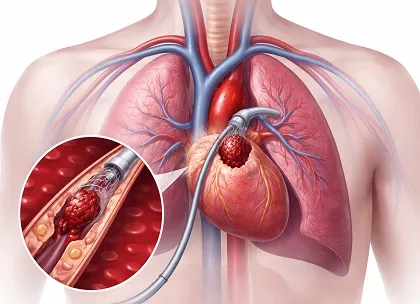
Doctors need better ways to judge catheter treatments for intermediate-risk pulmonary embolism. These patients face right heart strain from clots. Pulmonary vascular resistance measures right ventricle load directly. This study tests if it tracks treatment response and predicts results. The results were published in the European Journal of Acute Cardiovascular Care.
Single Center Tracks Hemodynamics
Researchers reviewed 131 patients from October 2020 to May 2025 with intermediate-high risk PE. All got large bore mechanical thrombectomy using pulmonary artery catheters. They measured PVR before and after procedures carefully. Main goal checked PVR change from treatment. Second goal found predictors of high post-procedure PVR over 2 Wood units. They also linked it to outcomes like death, cardiac arrest, instability, or 90-day readmission plus hospital stay length.
PVR Falls Fastest in Worst Cases
Median PVR dropped from 2.9 to 1.8 Wood units after thrombectomy. The p-value was under 0.001 showing strong effect. Patients with highest starting PVR saw biggest drops. Tertile 3 fell 50% versus 40% in tertile 2 and 20% in tertile 1. Post-procedure PVR stayed over 2 WU in 43.6% of cases. Severe PVR over 5 WU nearly vanished at 0.8% from 11.5% before.
High Post-PVR Means Trouble
Pre-procedure mean pulmonary artery pressure raised post-PVR odds with OR 1.07 (95% CI 1.01-1.14, p=0.026). Starting PVR also predicted it with OR 2.20 (95% CI 1.20-4.04, p=0.011). After age-sex adjustment, high post-PVR linked to 4.2 days longer hospital stays (95% CI 0.60-7.88, p=0.023). Composite bad outcomes hit 20.7% vs 5.3% with adjusted HR 4.02 (95% CI 1.28-12.61, p=0.017).
Track PVR in PE Cath Labs
PVR falls sharply after clot removal in sick lungs. High levels after predict longer stays and worse events. Use it to pick who needs closer watch.
Measure PVR Before and After
Cath labs should record it routinely. It guides who stays longer post-procedure.
Featured
Off
Page Content
#ffffff
Anonymous user
On
Authenticated user
On
Premium
On
Paid / Sponsored
On
Key highlights
- Researchers analyzed 131 patients with intermediate-high risk pulmonary embolism who underwent large bore mechanical thrombectomy from October 2020 to May 2025 with pulmonary artery catheter measurements.
- Median pulmonary vascular resistance decreased significantly from 2.9 to 1.8 Wood units after thrombectomy with p<0.001, showing greatest reduction in patients with highest baseline PVR values.
- Post-procedure PVR remained elevated above 2 Wood units in 43.6% of patients while severe PVR over 5 Wood units dropped from 11.5% pre-procedure to just 0.8% afterward.
- Pre-procedural mean pulmonary artery pressure and baseline PVR independently predicted elevated post-procedural PVR with odds ratios of 1.07 (95% CI 1.01-1.14, p=0.026) and 2.20 (95% CI 1.20-4.04, p=0.011).
- Elevated post-procedure PVR associated with 4.2 days longer hospital length of stay (95% CI 0.60-7.88, p=0.023) and four-fold higher composite adverse outcome risk at adjusted HR 4.02 (95% CI 1.28-12.61, p=0.017).
Source
Zhang RS, Zhang P, Yuriditsky E, et al. Effect of Large Bore Mechanical Thrombectomy on Pulmonary Vascular Resistance in Patients with Acute Pulmonary Embolism. European Heart Journal: Acute Cardiovascular Care. Published online January 30, 2026. doi: https://doi.org/10.1093/ehjacc/zuag016
Thumbnail
Speciality
Currency
Sub Speciality
Sub Sub Speciality
Short Description
Study of 131 intermediate-high risk PE patients shows LBMT cuts median PVR from 2.9 to 1.8 WU (p<0.001), with post-procedure PVR >2 WU raising composite outcome risk 4-fold.
User Segments
Release Date
Featured Order
0
Is Paid
0
Send Notification
Off