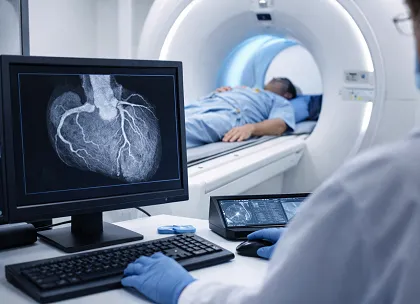
Use of noninvasive imaging for Coronary Artery Disease (CAD) has increased globally, with several modalities exposing patients to ionizing radiation. The study, published in JAMA, assessed worldwide radiation doses in adults undergoing CAD diagnostic testing.
A consecutive sample of 19,302 adults undergoing noninvasive CAD imaging at 742 centers in 101 countries during a single week between October and December 2023 was analyzed. Modalities included single-photon emission computed tomography (SPECT), positron emission tomography (PET), coronary artery calcium scoring (CACS), and coronary computed tomography angiography (CCTA). The primary outcomes were patient effective radiation dose and the percentage of centers with median effective dose less than or equal to 9 mSv, as recommended in guidelines.
Among participants (44% female; median age 63 [IQR 54-71] years), median (IQR) effective doses were 1.2 (0.7-2.2) mSv for CACS, 2.0 (1.6-2.4) mSv for PET, 6.5 (3.9-8.6) mSv for SPECT, and 7.4 (3.5-15.5) mSv for CCTA. More centers performing nuclear cardiology than CCTA achieved ≤9 mSv (81% vs 56%; P<0.001). Similarly, a greater proportion of patients undergoing nuclear cardiology than CCTA achieved ≤9 mSv (79% vs 56%; P<0.001). Doses varied by region, lowest in Western Europe and highest in Latin America (nuclear cardiology) and Africa (CCTA). In regression analysis, patient dose was 20% higher (95% CI, 3.6%-38.4%) in low- and middle-income countries than in high-income countries for nuclear cardiology, and up to 96% higher (95% CI, 41.7%-170.8%) in low- and lower-middle-income countries than in high-income countries for CCTA (P < .001).
These findings highlight global variation in radiation exposure from noninvasive CAD imaging and identify a critical need for training, standardized protocols, and updated equipment to reduce radiation dose worldwide, particularly in low- and middle-income countries and among patients undergoing CCTA.